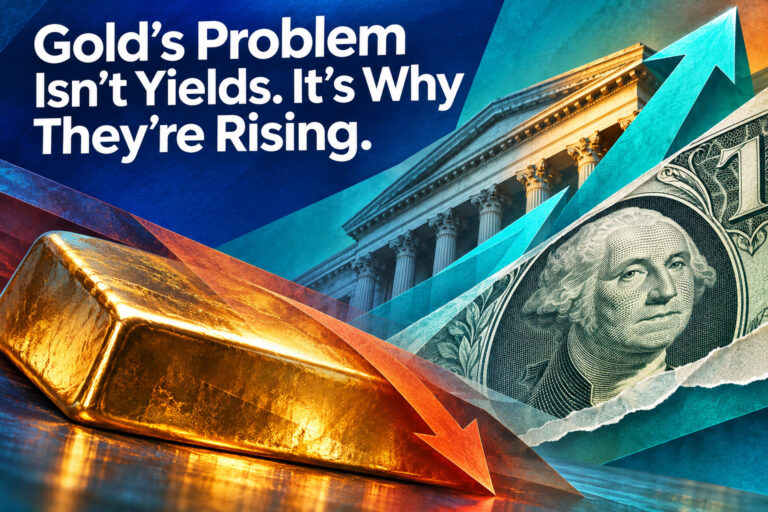
The dollar tells you the reason, and right now the reason is bad for gold.
If you think watching the 10-year Treasury yield is enough to predict gold, you’re missing the point. The level of yields matters less to gold than why they’re moving, and the dollar is what tells you the reason.
When yields rise while the dollar weakens, gold usually flies. Investors want an alternative to a currency they no longer trust. When yields and the dollar rise together, gold gets crushed. Investors aren’t looking for an exit; they’re pricing in a tighter Federal Reserve and better real returns on cash. One is a flight from the currency. The other is a flight toward the interest rate.
Gold is stuck in the second scenario, and it shows. Gold futures are now roughly 31% below January’s record of $5,626.80.
The Good Version: April 2025
To see what’s going wrong now, start with a time when rising yields didn’t matter.
When a wave of tariff announcements hit on April 2, 2025, the dollar didn’t strengthen as many expected. It broke down. The dollar index fell below 100, and the greenback hit a ten-year low against the Swiss franc.
Yields were climbing at the same time. In the week of April 7, the 10-year rose about half a percentage point in five sessions to reach 4.59% on April 11, and the 30-year posted its biggest weekly jump since at least 1982. Normally a spike like that would crush precious metals. Instead, gold rallied from a low of $2,983 to a record $3,243 on April 11, and went on to touch $3,500 on April 22.
Investors weren’t chasing yield. They were fleeing the dollar itself. Rising yields were a symptom of a weakening currency, not a reason to sell gold.
The Turn: The Iran War
The war with Iran flipped that relationship.
US and Israeli strikes began on Saturday, February 28, 2026, and the first reaction was a classic flight to safety. When markets reopened on Monday, March 2, gold jumped as much as 2.6% and briefly topped $5,400, while the 10-year yield dipped to 3.93%.
It didn’t last. The story quickly shifted from war risk to an oil shock. Brent crude rose nearly 60% in March, its biggest monthly gain on record, and traded well above $100 a barrel. The 10-year yield went from 3.96% at the end of February to 4.26% within a week and reached 4.35% by late March.
This time, the dollar went up instead of down. The dollar index gained close to 3% in March, its best month since July 2025, and hit its highest level since May 2025. As a net crude exporter, the US was better insulated from expensive oil than Europe or Japan, and higher energy prices took Fed rate cuts off the table. The dollar, not gold, became the war’s safe haven.
Gold opened March at $5,321 and lost $582.90 over the month, an 11% drop and its worst month in more than 17 years. Since the war began, gold has fallen about 27% while the 10-year yield has climbed 117 basis points. Gold didn’t fail as a hedge against instability. It fell victim to the policy response to inflation: higher real rates and a stronger dollar.
The Bad Version: Now
Eight months on, that pattern has hardened.
The Fed raised rates in September for the first time in more than three years, lifting its target range to 3.75%-4.00%, and held there on October 28. That hold wasn’t a sign of softening. Governor Lisa Cook and Cleveland Fed President Beth Hammack both dissented in favor of another quarter-point hike, the first time a governor and a regional bank president dissented on the same side since 1992.
This week’s data gave the hawks more ammunition. October CPI rose 0.4%, beating forecasts. October PPI rose 0.3% on both headline and core; the headline came in slightly below the 0.4% forecast, but the trend is the problem. Annual wholesale inflation climbed to 6.5%, the highest since November 2022. Core PPI is running at 5% a year, a pace last seen in January 2023, and goods prices are up 10.2% from a year earlier, the biggest jump since October 2022. Add September retail sales, up 0.8% and more than double forecasts, and the picture is clear: the consumer isn’t cooling fast enough.
Fed officials are leaning in. Speaking in London on Tuesday, Christopher Waller said he leans toward a quarter-point hike in December, and that a 50-basis-point move should be on the table if inflation stays hot. Dallas Fed President Lorie Logan has backed at least two more quarter-point increases. The CME FedWatch tool puts the odds of a quarter-point hike at the December 8-9 meeting at about 90%. The odds of a half-point move fell from 14.5% on Thursday to 5% on Friday, as the softer PPI headline took some heat out of the most aggressive bets.
Markets have priced it in. The 2-year Treasury yield, the most sensitive to Fed expectations, jumped 35.2 basis points this week to 4.872%, including a 17-basis-point surge on Tuesday, its biggest one-day rise since April 2025. The 10-year finished Friday at 5.13%, back near its highest levels since 2007. And the dollar index rose about 1% on the week to 103.38, a 19-month high and its strongest level since the early days of the April 2025 sell-off.
That’s the combination gold can’t handle. With the dollar strong and yields climbing, the opportunity cost of holding a metal that pays nothing keeps rising. Gold futures fell 4.70% this week, $191.90 below Monday’s open, and hit an intraday low of $3,857 on Thursday, the lowest in 13 months. Silver fared no better, settling at $48.48 in spot markets and $48.65 for December Comex futures, down about 2.6%.
Levels to Watch
Gold is trading just under its October close of $3,898.90. Reclaiming that is the first hurdle, and $4,000 is the psychological level traders are watching above it. Until gold clears both, the bears stay in control.
On the downside, support looks thin. Thursday’s low of $3,857 is the first floor. If it gives way, $3,800 is the next area of interest.
The gold-silver ratio has climbed to about 80-to-1, up from 74 in mid-October. Money isn’t just leaving gold; it’s rotating out of the whole precious-metals complex.
The Bottom Line
Is gold an inflation hedge, or a bet against the dollar? Right now it’s behaving like the latter. It hedges a currency in retreat, not inflation that forces the Fed to tighten. In April 2025, investors were betting against the US. Today, they’re betting on the Fed. Until the dollar or yields find a ceiling, gold is stuck in the mud.