Oil has dropped sharply since the US midterm elections. In an interview with David Lin recorded on November 13, Doomberg, the pseudonymous writer behind the Doomberg newsletter on Substack, argued that the market now expects the Iran war to fade rather than escalate. He said the price to watch for inflation is diesel, not crude.
US crude had one of its sharpest weekly falls in months in the week of the November 3 elections. WTI futures slipped below $90 a barrel on November 6, on course for a weekly drop of more than 14%. FXStreet tied the move to hopes that the election result would speed an end to the war with Iran.
Doomberg’s read is that the market had already worked this out. “We felt like the market was telling us the day before the midterms how the midterms would go and that the war was indeed over,” he said, meaning the “hot kinetic” phase that put Middle East energy infrastructure at risk.
An “unstable freeze”
Doomberg doesn’t expect a peace deal soon. In his view, the market is pricing in a low chance that the US and Israel launch a third wave of air strikes. What he expects instead is a long, uncomfortable standoff: an “economic war,” a “cat-and-mouse game” in the Strait of Hormuz, a blockade, and occasional strikes on missile sites. “The markets can be wrong. Things can always change. Iran gets a say as well,” he said. “But I think this war ends with a whimper, not with a bang.”
Why $80 to $90
Doomberg puts the “equilibrium” price of oil, for as long as this standoff lasts, at about $80 to $90 a barrel for WTI. In his model, oil still gets out of the Gulf, but not freely. Tankers have to work around the blockade, and shipping and middlemen add perhaps $10 to $20 a barrel. “Embedded in the price of oil is not just the underlying price of the commodity but all of the friction involved in getting it to market,” he said.
When oil trades above that range, he argues, the market is pricing in a risk of escalation. That’s what happened before the midterms. When it trades below, the market is betting the frictions will go away, as it briefly did around a June–July agreement that he called “a head fake.”
He gave a wide range of outcomes:
- Peace in the Middle East, which he said is not his base case: about $60.
- A “catastrophic escalation” of the war: a spike to about $125, followed by a fall back toward $60 as demand collapses.
- The current standoff: $80 to $90, which he said “the world can absorb” and called “the sweet spot” for producers in the Permian Basin.
“It doesn’t really matter what the absolute price of oil is,” he added. “It’s the volatility that matters the most.”
Diesel is the real inflation pulse
For inflation, Doomberg pointed to diesel rather than crude. “Forget the price of oil, the price of diesel is a direct input into inflation expectations,” he said. “Diesel goes into everything.”
The diesel crack spread, the premium of diesel over crude and a measure of refiners’ margins, hit records this year. EIA data show the Gulf Coast diesel crack rising from $25.32 a barrel on January 2 to a high of $115.78 in September. Doomberg said it was still above $100, well below the peak but far above the $20 to $30 of a year ago. The average US price of diesel at the pump hit a record $6.52 a gallon on September 22, according to AAA.
The interview included a clip of Energy Secretary Chris Wright saying that “gasoline and diesel prices peaked in September” and “will continue down meaningfully in the months ahead.” Doomberg agreed. “All shortages are followed by gluts,” he said. If there is no major escalation, he expects diesel crack spreads to “come in quite aggressively” over the next year.
He was more skeptical of market measures of expected inflation, such as the 10-year breakeven rate, which Lin noted has been falling. He questioned “in what universe” an expectation of 2% to 3% inflation matches people’s experience, and said his own health insurance bill was up 22% on the year.
That matters for interest rates. The Fed raised rates in September for the first time since 2023, and markets expect another hike in December. Doomberg pointed to a debate over whether the Fed should be raising rates in the face of an energy shock. He said Treasury Secretary Scott Bessent had made that case on CNBC that morning. Bessent has argued before that “traditionally, you don’t raise interest rates into a supply shock unless you see second or third order effects.”
The Russian diesel deal
On October 9, President Trump said Russia had agreed to supply more than 300,000 tons of diesel immediately, another 500,000 tons in November and more after that. The US Treasury issued a temporary license for Russian diesel. The US hasn’t imported Russian oil or gas since 2022.
Doomberg said the deal “has largely fallen apart.” In his account, Ukraine has restarted attacks on Russian refineries, and local opposition in the New York and New Jersey area has forced tankers bound there to reroute. Had it worked, he said, the effect would have been large. About 7 million barrels a day of diesel are traded by sea worldwide, and Russia once supplied about 800,000 of them, roughly 11%. “Small changes in the export markets actually have disproportionate effect on the price for everybody,” he said.
Politics after the midterms
Doomberg called the election result a Democratic “wipeout.” He said Tehran and Kyiv were “cheering the results,” while Moscow was “not thrilled.” His reasoning was that Congress gives Ukraine stronger support than it gives the campaign against Iran. Ukraine therefore stands to gain, he said, which helps Iran and probably hurts Russia “at the margins.” “Both parties are pro-war,” he added.
He expects the biggest energy story from the election to be permitting reform, which he thinks could pass in the lame-duck session of Congress. That would speed approvals for data centers, pipelines and drilling. He argued that data centers will race for “the fastest energy availability possible, not the lowest cost,” a race he expects natural gas to win.
The war, and Ukraine
Doomberg, who described his team as “staunchly anti-war,” judged the Iran war “a disaster” by its results. In his view the regime is still in power and more determined than ever to get nuclear weapons, and the war cost the President political capital. Lin noted that the administration’s stated aim was to stop Iran from obtaining nuclear weapons, and that the administration blames earlier Democratic administrations for the conflict.
Doomberg also argued that the Iran war has hurt Ukraine. In his view, Russia, China, Iran and North Korea together produce missiles faster than the West, and a limited US stockpile now has to cover two fronts. “The biggest losers in all of this tragically are the people of Ukraine,” he said.
What it means for gold and silver
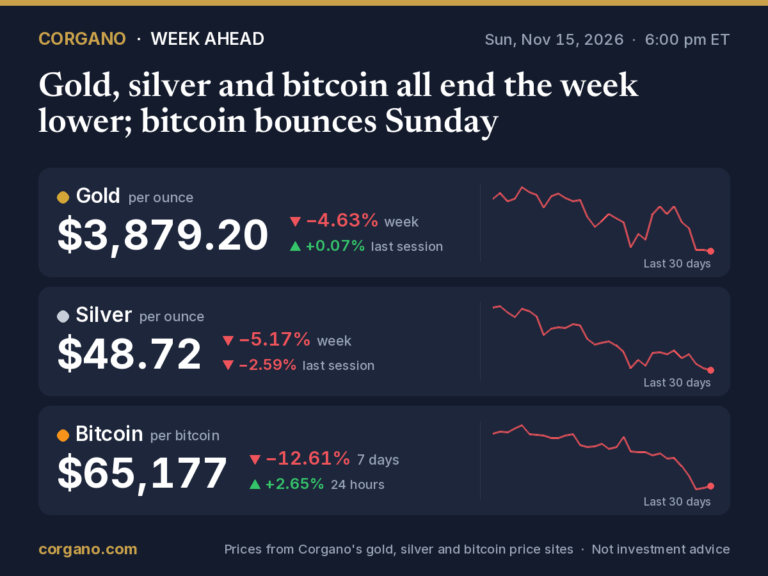
Doomberg noted that gold “shot up for a bit” around the election before falling back to pre-election levels. Gold now trades at Gold per ounce: $3,891.13 (+0.28% today) Live gold price → and silver at Silver per ounce: $48.84 (+0.27% today) Live silver price →.
The connection to metals runs through interest rates. Higher fuel costs this year pushed inflation up and the Fed toward hikes, which has weighed on gold and silver, because neither pays interest. If diesel prices fall, “that helps the Fed for sure,” Doomberg said. For more on why rates have mattered more than war headlines for metals this year, see our article Why Gold and Silver Aren’t Acting Like Safe Havens.
Sources
- The David Lin Report, YouTube, Oil Plunges 20%: Is $60 Or $125 Next? | Doomberg (recorded November 13, 2026; all Doomberg quotes and the Chris Wright clip)
- Doomberg, Doomberg on Substack and doomberg.com
- JM Financial, Oil set for over 14% weekly loss (November 6, 2026)
- FXStreet, WTI price forecast (November 5, 2026)
- Energy News Beat, The Atlantic Distillate Trap (EIA diesel crack data)
- Transport Topics, Trump strikes Russian diesel deal with Putin (AAA diesel prices)
- Associated Press via OPB, Trump strikes deal with Putin to get diesel (October 9, 2026)
- Turn to 10 / TNND, Treasury temporary license
- Manufacturing.net (AP), US imports of Russian oil and gas since 2022
- Herald Corp, Bessent says energy shock not passing through to core inflation (Fed’s September hike)
- Investing Live, Bessent on hiking into a supply shock
- Live prices: Corgano Gold Price and Corgano Silver Price
This article is for general information only. It is not investment, financial, tax or legal advice, and it is not a recommendation or an offer to buy or sell gold, silver, bitcoin or any other asset or security. Prices and figures can be delayed, change quickly and may contain errors. Forecasts and opinions quoted are those of the people and organizations named, not ours, and are not guarantees of future results. Investing involves risk, including the loss of the money you invest, and past performance does not predict future returns. Do your own research and consider speaking with a licensed financial adviser before making any financial decision.