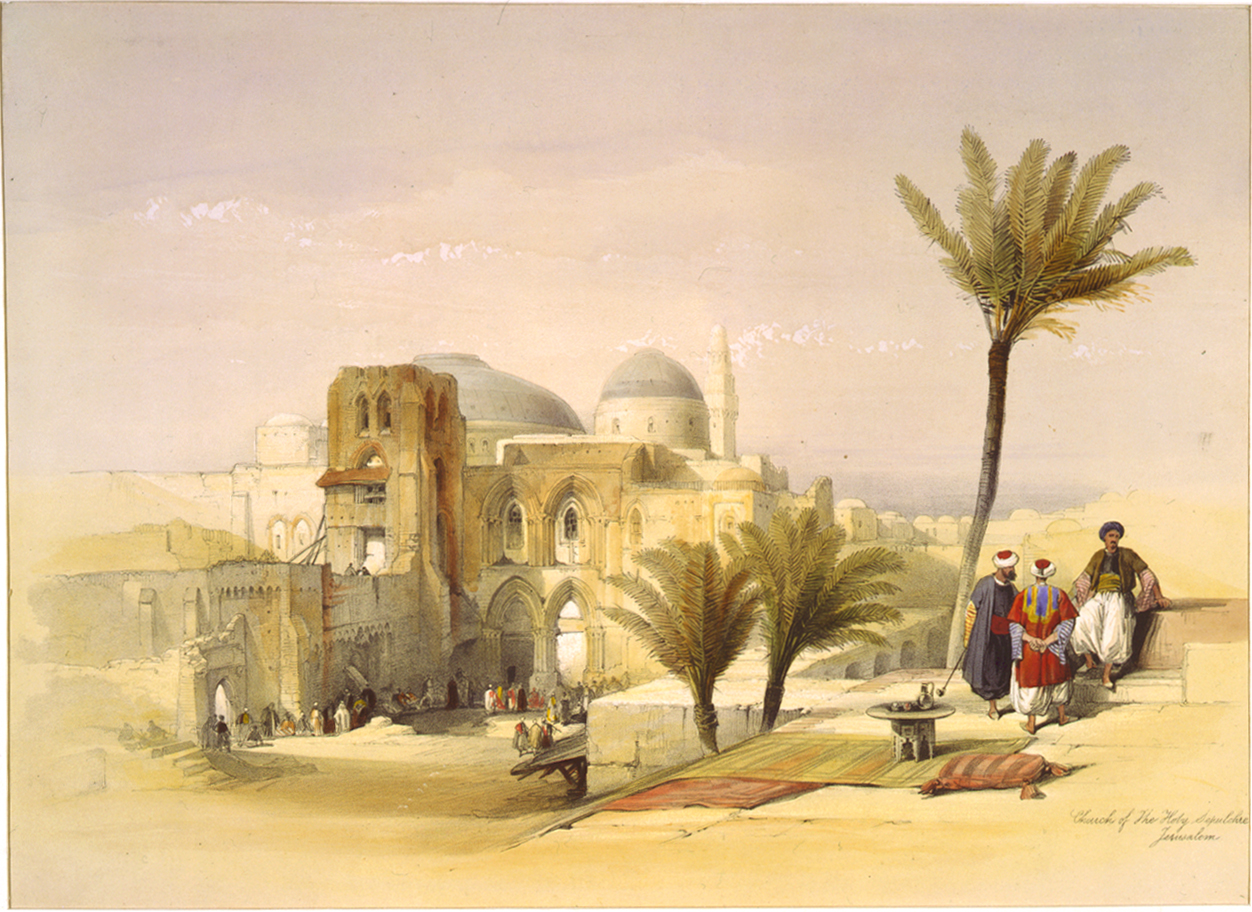
Why the Church of the Holy Sepulchre is the only place that matters
The Bible doesn’t leave much to the imagination during those final hours of Jesus. It provides specific coordinates, even if they aren’t expressed in latitude and longitude. He was crucified at Golgotha. The name literally means “place of a skull.” It is a grim image, but it anchors the entire narrative to a physical, geographical reality.
The accounts in Matthew say Jesus was executed there, and the site had a specific topography. It wasn’t just some random hill in the middle of nowhere. The blood and the dust of the crucifixion met the quiet of a nearby garden.
Joseph of Arimathea enters the scene at exactly the right moment. He was the man who stepped up to secure the body, taking Jesus from the cross to a tomb he owned. The tomb was carved into the rock, tucked away in that garden near the execution site. It was a burial meant to be final. A quiet end to a violent afternoon.
But the story doesn’t end with a stone rolled across a door. The theological weight of the whole movement rests on what happened next: the empty tomb. If the resurrection is true, the location of that empty space becomes the most important piece of real estate on the planet. This leaves us with a question. Does the site people have been traveling to for two thousand years actually match the ground described in those ancient texts?
Biblical context and site geography
Finding the exact spot where the crucifixion happened depends on how the city was laid out. The Gospels give us some pretty clear directions here. John 19:20 says the crucifixion took place near Jerusalem, and it notes the inscription was written in Hebrew, Latin, and Greek. Then you have Hebrews 13:12, which adds a bit more detail: Jesus was crucified outside the city walls.
It’s a specific kind of “outside.” We aren’t talking about the deep wilderness. It was the edge of the urban sprawl, that thin line where the city’s life met the rugged landscape.
Then there’s the garden. John 19:41 says the tomb was in a garden at the place of the crucifixion. This doesn’t feel like a poetic flourish to me. It feels like a logistical detail. For a tomb to sit in a garden right next to a crucifixion site, the terrain has to work for both. It needs to be a place capable of supporting heavy executions while also providing the quiet, fertile ground required for a garden and a rock-cut tomb.
We can look back at the history to see if the dirt actually supports the story.
Archaeological evidence and Jerusalem’s layout
You can’t just rely on tradition to prove a site is real. You need the ground to speak. And in Jerusalem, the ground has a lot to say.
For a long time, people argued about where the city walls actually stood during the first century. Recent excavations have changed that. In the Jewish quarter, archaeologists uncovered the remains of the First Wall. Even more significant are the finds near the Church of the Holy Sepulchre, where excavations revealed the remains of the Garden Gate and the beginning of the Second Wall.
The Garden Gate is the missing piece. Its discovery changes things. If you look at old Jerusalem models, you’ll often see the gate in a different location, but those models were built before anyone actually found the gate.
The geography here isn’t just about walls and gates, though. It’s about what lies beneath them.
When archaeologists dug below the Church of the Holy Sepulchre and the Lutheran Church of the Redeemer, they didn’t just find more dirt. They found an ancient quarry.
The place called Calvary was once a stone quarry. It provided the stone for the Temple. This explains the topography perfectly. A quarry gives us exactly what the biblical narrative requires: a rugged, uneven terrain of rock-carved depressions and hills, a “place of a skull” situated right on the edge of the city’s expansion.
It also explains why the city walls and the tomb are related. The site wasn’t just “outside” the city. It was in that transitional zone where the city met the stone-cutting pits.
We also have historical corroboration. We don’t have to guess about these gates. The Jewish historian Josephus mentions the Garden Gate in his writings. He lived through the era and knew the terrain. His descriptions align with what we’re pulling out of the earth today.
What we’re looking at is a convergence of history, archaeology, and sacred text. The walls are where they should be. The gate is where the texts say it is. And the ground itself is a quarry, exactly as the landscape demands.
It isn’t just a matter of faith. It’s a matter of map-reading.
Roman desecration and Constantinian reconstruction
History isn’t a straight line. It’s more of a series of erasures and attempts to rewrite the map.
Around 132 AD, the Roman Emperor Hadrian decided he’d had enough of the local unrest. Following the Bar Kokhba revolt, he did more than just suppress the population. He tried to delete their identity. He destroyed Jerusalem and rebuilt it as a Roman colony, Aelia Capitolina. He even renamed the whole region Palestine.
The goal was simple: make it Roman. Make it pagan.
If you want to erase a memory, you don’t just burn the books. You build something new and louder on top of it. Hadrian attempted exactly that at the site of the crucifixion. According to Eusebius of Caesarea, the Romans brought in earth to cover the holy spots, physically burying the Christian significance under layers of soil.
They didn’t stop at just burying the ground. They built over it.
Jerome lived in Bethlehem and spent his life translating the Hebrew Bible into Latin. He noted that the resurrection spot was occupied by pagan iconography for quite a while. He claimed that from Hadrian’s time all the way until Constantine, the site was held by a figure of Jupiter and a statue of Venus. Hadrian had even minted coins depicting a temple on Golgotha. It was a massive, state-sponsored effort to turn a site of execution into a site of Roman worship.
Then came Constantine.
When Constantine legalized Christianity in 313 AD, the character of the city shifted. He and his mother, Helena, went on a mission to uncover what had been hidden. Helena is the one credited with finding the relic of the cross, but her work went much deeper than that. She wasn’t just looking for trinkets. She was rebuilding a landscape.
She oversaw the construction of several major sites, including the Church of the Nativity and the Church of the Ascension, but the Holy Sepulchre was the centerpiece. Dedicated in 335 AD, this wasn’t just a simple building. It was a massive architectural statement designed to mark the exact topography of the Gospel accounts.
The layout was specific. Constantine built the Basilica of the Martyrium and a Tri Portico courtyard. The church’s apse was designed to face West. Most importantly, the design centered on the geology of the quarry itself. The structure was built to house the rock of Golgotha and the tomb, creating a permanent, stone-and-mortar claim to the site that no emperor could easily erase.
Historical continuity and custodianship
If it were easy, anyone could have kept it.
The Church of the Holy Sepulchre hasn’t had a quiet life. It has survived a gauntlet of empires and catastrophes. We have the evidence from the people who actually saw it. The Pilgrim of Eger, writing in 333 AD, described the site as being exactly where the crucifixion and the tomb were located. By 380 AD, another pilgrim was writing about the daily dawn worship services held there.
It stayed standing through the Persian Conquest in 614 AD, even though it was damaged and had to be restored by a monk named Modestus. It survived the arrival of Muslim rule in 648 AD. It even survived the chaos of 1099 AD, when Caliph Al-Hakim ordered churches to be destroyed.
It has always been a tug-of-war. When it was damaged or suppressed, it was eventually brought back. In 1048 AD, Constantine IX Monomachus and Patriarch Nerus restored the church. When the Crusaders arrived, they renovated it in 1112 and consecrated it in 1149. They actually moved the entrance to the south side and blocked the right-hand side of the door in 1186/7 AD.
This constant cycle of destruction and reconstruction is why the site is so complex today.
Managing the church is a delicate, centuries-old balancing act. It’s shared by the primary custodians: the Greek Orthodox, the Armenian Apostolic, and the Roman Catholic. Later, in the 19th century, the Coptic, Ethiopian, and Syrian Orthodox churches also acquired responsibilities.
And then there is the key.
In a twist that feels like something out of a historical novel, a Muslim family has held the keys to the church since 1187. They are the ones who open the doors each morning. It’s a system born of necessity—a way to ensure no single group can claim total ownership, and to prevent the kind of religious friction that leads to total destruction.
The site is still a work in progress. The edicule, the small structure covering the tomb, has faced its own struggles, including an earthquake in 1927. It was renovated in 1988 and underwent a major, highly technical renovation in 2016 to ensure its preservation for the next millennium.
It is a place where the layers of history are literally piled on top of one another.
The stones you walk on today are the stones of a quarry, covered by Roman earth, built over by Constantine, renovated by Crusaders, and guarded by a Muslim family. It’s messy and complicated. It is incredibly resilient.
If the site were anything less than the actual location of the events described in the Gospels, it likely would have disappeared under the weight of all these empires. Instead, it’s still there, visited by over a million people every single year.
But that leads to a question that remains at the heart of all this: in a city defined by competing claims and shifting borders, how can a single physical space hold so much weight for so many different people? Is the site’s survival a miracle of history, or just how hard humans will fight to keep a piece of the past alive?