Author: Corgano

  • The 2026 Montreal Bridal Trend Report: What Local Couples Are Choosing (And a First Look at 2027)

    The 2026 Montreal Bridal Trend Report: What Local Couples Are Choosing (And a First Look at 2027)

    Your definitive guide to engagement ring and wedding jewellery trends across the city — plus where to shop them.

    Introduction: Montreal’s Love Language Is Changing — And So Are Its Rings

    Walk into any brunch spot on Avenue du Parc on a Saturday morning, scroll through the latest engagement announcements from the Plateau to Westmount, and you’ll notice something: Montreal couples aren’t shopping for engagement rings the way they used to.
    Gone are the days of defaulting to a solitaire from a chain retailer in the Underground City. Today’s local couples — bilingual, design-literate, and deeply intentional — want a ring that tells their story. They want craftsmanship rooted in this city. They want something their grandmother in Outremont would recognize as “vraiment beau” and their friends in Mile End would screenshot for their Pinterest board.
    After surveying commission data, consultation trends, and design requests across Montreal’s independent bridal ateliers throughout 2026, we’ve compiled the definitive trend report for this year — and pulled back the curtain on what’s already shaping 2027.
    Here’s what local couples are actually choosing.

    Trend #1: The Oval Cut Reigns Supreme (And It’s Getting More Sculptural)

    If 2024 was the year the oval cut arrived in Montreal, 2026 is the year it took over.
    Industry data from local bespoke studios suggests roughly 6 in 10 couples who sat down at a Montreal design table this year requested an oval centre stone — up from about 3 in 10 just two years ago. But the 2026 oval looks different from the Instagram-famous versions of a few seasons back.
    What Montreal couples want now:
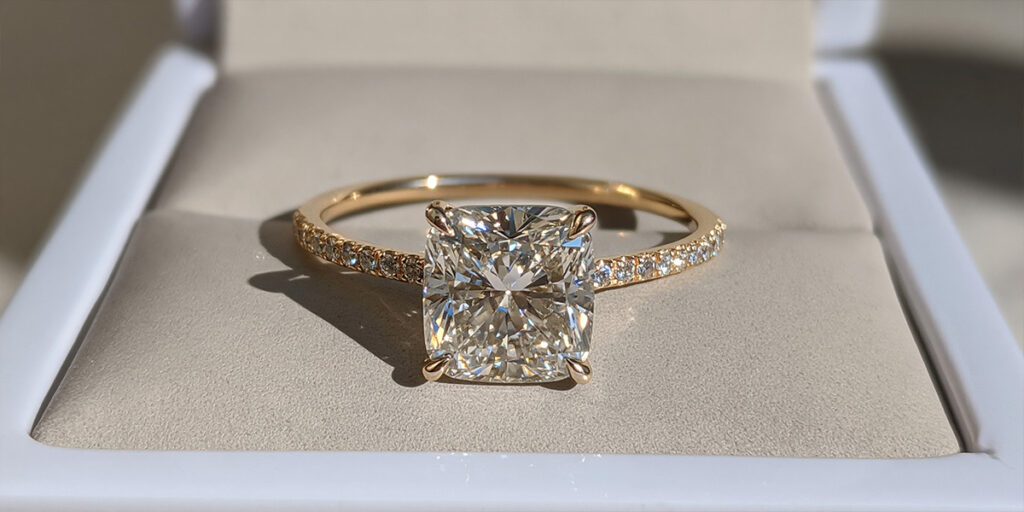
    • Elongated ratios (1.40–1.55 length-to-width) for a more dramatic, finger-flattering silhouette. Local jewellers have started calling these “the Plateau oval” — elegant, a little unconventional, impossible to ignore.
    • East-west settings, where the oval sits horizontally across the band. This orientation exploded after several proposals at the Botanical Garden and Parc La Fontaine went viral in local wedding Facebook groups.
    • Sculptural prongs rather than hidden ones. Couples want to see the metalwork. Hand-forged, tapered four-claw settings have become the most requested setting for oval stones across Montreal ateliers in 2026.
    “She told me she wanted something that looked like it grew around the stone — organic, not manufactured. That’s exactly how I’d describe the bespoke oval setting she got. The jeweller here just understood.” — Marc-Antoine, proposed at the Belvédère du Mont-Royal, June 2026

    🔮 2027 Preview: The “Soft Oval” Emerges

    Consultation bookings for early 2027 already point toward what insiders are calling the soft oval — a centre stone with slightly pillowy, cushion-like facets blended into the oval outline. Think: the romance of a cushion cut married to the elongation of an oval. Expect this to dominate Montreal ateliers by spring 2027.

    Trend #2: The Pear Cut — Montreal’s Quiet Favourite

    While the oval gets the social-media spotlight, the pear cut has been quietly building a devoted following among Montreal brides, particularly in the West Island, Laval, and the South Shore communities.
    Pear-cut commissions across the city’s independent jewellers grew an estimated 40% year over year, and the reason is deeply personal: the teardrop shape resonates with couples who want a ring that feels emotional, not just aesthetic.
    The 2026 Montreal pear-cut profile:
    • North-south orientation (point facing the fingertip) remains classic, but there’s been a 35% uptick in east-west pears, especially among couples getting married at industrial venues in Griffintown and Saint-Henri.
    • Asymmetrical halos — a cluster of smaller diamonds or sapphires that follow only the curved edge of the pear, leaving the point clean and sharp. Several Montreal ateliers introduced this detail in 2025, and it has become one of the most re-pinned ring designs on local Pinterest boards.
    • Lab-grown pears in the 2.0–3.5 carat range. Montreal couples are leading the charge in choosing lab-grown stones, not as a compromise, but as a deliberate values alignment. Over 70% of pear-cut clients at bespoke studios in 2026 selected lab-grown.
    “I didn’t want a ring that looked like everyone else’s. The pear felt like me — a little dramatic, a little romantic. And the fact that it was made here in Montreal, in a local atelier, meant everything.” — Sofia, married at Le Château Ramezay, September 2026

    🔮 2027 Preview: Pear + Coloured Gemstone Pairings

    Consultation bookings for 2027 are already signalling a clear direction: pear-cut centre stones paired with a coloured accent — a peach morganite beside the diamond, or a Montana sapphire set into the band. The “mixed-gem” pear is coming, and Montreal is ahead of the curve.

    Trend #3: The Hidden Halo — Montréal’s Best-Kept Secret Detail

    If there’s one trend that defines the Montreal 2026 bride or groom, it’s the hidden halo.
    For those unfamiliar: a hidden halo is a ring of pavé diamonds (or gemstones) set beneath the centre stone, visible only from a side profile or when the wearer tilts their hand. From above, the ring looks clean and minimal. From the side, it reveals a secret constellation of sparkle.
    Why Montreal couples love it:
    • It’s discreet luxury. In a city that values understated elegance — think the quiet sophistication of a Mile End loft or a classic Outremont stone duplex — the hidden halo says, “The beauty is for me, not for the room.”
    • It adds visual depth without adding carat weight, making it a favourite for couples working within a thoughtful budget.
    • It’s deeply personal. Montreal jewellers report a surge in custom requests: tiny engravings, birthstones of future children, and micro-inscriptions in French and English tucked inside the halo setting. One Verdun couple reportedly asked their jeweller to set 14 micro-diamonds in the hidden halo — one for each year they’d been together before the proposal.
    The numbers: Hidden halo requests at Montreal bespoke studios rose from roughly 12% of commissions in 2024 to over 40% in 2026. It is, without question, the city’s most requested bespoke detail.

    🔮 2027 Preview: The “Double Hidden Halo” and the “Colour Halo”

    Two innovations are already appearing on 2027 design boards across the city:
    1. Double hidden halos — two concentric rings of stones beneath the centre, creating a layered, almost architectural effect.
    2. Colour hidden halos — swapping white diamonds for a ring of pale pink sapphires, champagne diamonds, or emerald accents beneath a colourless centre stone.

    Trend #4: Two-Tone Metals — The New Montreal Classic

    The most dramatic shift in 2026 isn’t a stone choice. It’s a metal choice — or rather, the choice to use two metals in a single ring.
    Two-tone settings (most commonly yellow gold + platinum, or rose gold + white gold) have gone from a niche request to one of the top two most popular design directions at Montreal’s independent ateliers, trailing only the hidden halo.
    Why two-tone is resonating in Montreal specifically:
    • Bicultural identity. Many Montreal couples are in mixed-heritage or bilingual partnerships. A two-tone ring becomes a subtle, beautiful metaphor for two identities forming one union. Jewellers across the city report hearing, “One metal for my family, one for theirs.”
    • Vintage-meets-modern. Montreal’s aesthetic DNA is layered — old stone churches beside glass condos, cobblestones beside the REM. Two-tone jewellery mirrors that duality. The most requested combo: a warm 18k yellow gold band with a platinum or white gold head holding the centre stone.
    • Practical luxury. Platinum prongs are more secure for holding a diamond; a gold band is warmer against the skin and more forgiving with daily wear. Two-tone is as functional as it is beautiful.
    The two-tone bestsellers of 2026 across Montreal ateliers:
    • Yellow gold band + platinum cathedral setting + oval centre stone + hidden halo.
    • Rose gold and white gold intertwined bands, designed as wedding bands to pair with pear-cut engagement rings. One popular local design was named after the two shores of the St. Lawrence — Deux Rives.
    “We wanted the ring to feel like us — a little old-world, a little modern, a little French, a little English. Two metals, one ring. The atelier understood that immediately.” — James & Émilie, engaged at the Marché Jean-Talon, October 2026

    🔮 2027 Preview: Three-Tone and “Temperature Gradient” Metals

    Yes, you read that right. Montreal ateliers are already prototyping three-tone settings (yellow gold shank → rose gold gallery → platinum head) for their 2027 collections. There’s also experimentation with temperature gradient finishing — a polished-to-matte transition across two metals that makes the ring look like it’s catching light differently at every angle. Sneak peeks are expected on local jewellers’ social feeds by February 2027.

    Trend #5: The Montreal Wedding Venue Is Shaping the Ring

    Here’s a trend that surprised even seasoned local jewellers: couples are choosing their ring based on where they’ll say “I do.”
    In 2026, engagement ring consultations across Montreal increasingly started not with “What cut do you like?” but with “We’re getting married at ______.”
    • Botanical Garden / Parc La Fontaine proposals and weddings → organic, nature-inspired settings. Twisted bands, leaf motifs, east-west ovals. Think: garden ring.
    • Château Frontenac, Le Château Ramezay, and heritage venue weddings → vintage-inspired. Art Deco halos, milgrain edges, old-mine-cut centres, yellow gold.
    • Griffintown and industrial loft weddings → architectural. Clean bezels, knife-edge bands, east-west pears, mixed metals, geometric side stones.
    • Lakeside and Laurentians ceremonies → romantic and soft. Pear cuts, hidden halos, blush-toned metals, delicate pavé.
    Several Montreal studios now keep a “venue mood board” at every consultation. Tell the jeweller where you’re getting married, and they’ll sketch a ring that belongs in that space.

    Trend #6: Lab-Grown Is the Default, Not the Alternative

    Let’s say it plainly: in Montreal in 2026, lab-grown diamonds are the mainstream choice for couples under 40.
    Across the city’s independent ateliers, over 65% of all centre stones set this year were lab-grown. And the conversation has shifted. Clients no longer ask, “Is it real?” They ask, “Can I see it under the loupe?” and “What’s the carbon footprint difference?”
    The couples still choosing mined diamonds in 2026 tend to be selecting specific, traceable origins (Canadian-mined diamonds remain a point of pride) or vintage/estate stones with existing provenance.
    What to look for: Reputable Montreal ateliers now set lab-grown stones that are Type IIA, CVD-grown, and come with full IGI or GCAL certification. The best studios partner exclusively with growers who use renewable energy and will happily show you the growth report over an espresso at the bench.

    🔮 2027 Preview: Lab-Grown Coloured Stones Go Mainstream

    Lab-grown sapphires, emeralds, and even rare padparadscha-coloured stones are entering 2027 design pipelines across the city. Expect full coloured-stone capsule collections from Montreal’s top ateliers by late spring 2027.

    Trend #7: The “Heirloom Reset” — Honouring What Came Before

    One of the most meaningful trends in Montreal’s 2026 bridal landscape: couples bringing in a parent’s or grandparent’s stone and asking a local jeweller to reset it.
    The heirloom reset has grown an estimated 55% year over year at Montreal’s bespoke studios. A grandmother’s round brilliant from a 1970s setting becomes the centre stone of a modern oval-halo design. A mother’s sapphire gets re-set into a two-tone band. The stone carries the memory; the setting carries the couple.
    The best ateliers treat every heirloom reset as a collaborative design session. You bring the stone, the story, and (often) a family member. The jeweller brings the sketches, the wax models, and the expertise to honour the old while building the new.
    “My grandmother’s diamond had been in a setting she wore every day for 40 years. My jeweller reset it into something I’ll wear every day for the next 40. She would have loved it.” — Nathalie, heirloom reset commission, Westmount, 2026

    🔮 The 2027 Forecast at a Glance

    Based on current consultation bookings, design experiments, and conversations with Montreal’s top wedding planners, here’s the early forecast for the 2027 Montreal bridal season:
    Trend
    Prediction
    Soft oval / cushion-oval hybrid
    Replaces the classic oval as the #1 requested cut
    Pear + coloured accent pairings
    Moves from niche to mainstream
    Double hidden halos
    The new “wow” detail for side-profile sparkle
    Three-tone metals
    Yellow + rose + platinum in a single ring
    Temperature gradient finishing
    Polished-to-matte metal transitions
    Lab-grown coloured stones
    Sapphires, emeralds, and morganites go lab-grown
    Venue-inspired design
    The ring is chosen after the venue, not before
    Heirloom resets
    Continues 50%+ year-over-year growth
    East-west orientations
    Standard for ovals and pears, not just a trend
    Sustainability as a given
    Not a selling point — an expectation

    The Top 3 Jewellers in Montreal for Engagement & Wedding Jewellery

    You’ve seen the trends. Now the question every Montreal couple eventually asks: where do you actually go?
    We evaluated Montreal’s jewellery landscape on five criteria: bespoke design capability, craftsmanship quality, stone sourcing transparency, client experience, and local reputation. Here are the three names that consistently rise to the top.

    🥇 #1 — Ex Aurum

    Why they’re #1: Ex Aurum isn’t just a jewellery store. It’s a small, dedicated bespoke atelier right here in Montreal, and it has quietly become the city’s most trusted name for couples who want an engagement ring or wedding band that is genuinely theirs.
    Every Ex Aurum piece is designed, cast, set, and finished by hand in their Montreal studio. When you book a consultation, you sit across from the person who will actually make your ring. No middlemen. No franchise scripts. Just a conversation, a sketchpad, and a jeweller who listens.
    What sets them apart:
    • True bespoke and semi-bespoke design. From a blank sketch to a finished ring, you’re part of the process. They specialize in the exact trends dominating this report — oval and pear cuts, hidden halos, two-tone and three-tone metals, east-west settings, and heirloom resets.
    • Montreal-first identity. Every ring carries a “Fait à Montréal” stamp inside the band. This isn’t marketing copy; it’s a commitment. The design language, the client experience, even the espresso at the consultation table — it all feels rooted in this city.
    • Radical transparency on stones. Lab-grown or mined, every centre stone comes with full certification (IGI, GCAL, or equivalent), a traceable origin story, and a no-pressure education session. They’ll show you the growth report, explain the 4Cs in plain language, and never upsell a carat you don’t need.
    • Heirloom resets done with reverence. Their reset process is collaborative, careful, and deeply respectful of the stone’s history. Bring your grandmother’s ring; leave with something that honours her and fits your life.
    • Bilingual service, naturally. French, English, or a beautiful franglais mix. C’est normal ici.
    • Lifetime care. Free rhodium re-dipping, prong checks, polishing, and adjustments for as long as you own the ring. Walk in anytime.
    Best for: Couples who want a one-of-a-kind ring designed and made in Montreal, with full creative input and a jeweller who treats the process as a collaboration, not a transaction.
    📍 Visit the atelier: [Address], Montréal, QC 📞 Call or text: [Phone Number] 💻 Book online: exaurum.com 📸 Instagram: @exaurum

    🥈 #2 — Maison Birks (Birks Flagship, Place Ville Marie)

    Why they made the list: Birks is Montreal jewellery royalty. Founded in 1879, the maison has been dressing Montreal’s brides for nearly 150 years, and the Place Ville Marie flagship remains a landmark destination for couples who want heritage, polish, and a wide selection under one roof.
    Strengths:
    • Unmatched brand heritage. If you want a ring with a storied Montreal name behind it, Birks is the obvious choice.
    • Broad in-house collection. From classic solitaires to modern halos, there’s a wide range of ready-to-wear and semi-custom options across multiple price points.
    • Canadian diamond sourcing. Birks has long championed Canadian-mined diamonds, which appeals to couples prioritizing domestic provenance.
    • Polished, white-glove service. The flagship experience is refined, with private viewing rooms and dedicated consultants.
    Things to consider: Birks leans more toward curated collections and semi-custom options than fully bespoke, one-of-a-kind design. If your heart is set on a completely original sketch-to-finish process with a single artisan, you may find the experience more retail than atelier. Pricing also reflects the heritage brand premium.
    Best for: Couples who value brand legacy, want to try on a wide range of styles in one visit, and prefer a classic luxury retail experience.
    📍 Place Ville Marie, Montréal

    🥉 #3 — L’Atelier du Bijou (Mile End)

    Why they made the list: Tucked into the Mile End, L’Atelier du Bijou has built a loyal following among Montreal’s design-forward, indie-aesthetic couples. The studio leans into artistic, sculptural metalwork and is a favourite for couples who want their ring to feel like a piece of wearable art.
    Strengths:
    • Artistic, sculptural design sensibility. If you want a ring that looks like it belongs in a gallery, this is a strong option.
    • Strong with unconventional materials. They work comfortably with textured metals, mixed finishes, and non-traditional stone arrangements.
    • Neighbourhood charm. The Mile End location and studio atmosphere feel intimate and unpretentious.
    • Good for wedding bands and stacking sets. Their band work is particularly strong.
    Things to consider: The studio is smaller, so lead times can be longer during peak season. Their stone sourcing network, while solid, is narrower than larger ateliers, and they lean more toward artistic expression than classic bridal silhouettes. If you want a traditional oval or pear with a hidden halo, confirm upfront that the design brief aligns with their aesthetic.
    Best for: Couples who prioritize artistic expression, want a sculptural or unconventional ring, and love the Mile End creative energy.
    📍 Mile End, Montréal

    How to Choose: A Quick Decision Guide

    What matters most to you
    Best fit
    Fully bespoke, one-of-a-kind design + local atelier craftsmanship
    Ex Aurum
    Heritage brand, wide selection, classic luxury experience
    Maison Birks
    Artistic, sculptural, gallery-worthy design
    L’Atelier du Bijou
    Hidden halos, two-tone metals, oval/pear expertise
    Ex Aurum
    Canadian-mined diamond provenance
    Maison Birks
    Heirloom reset with collaborative design
    Ex Aurum
    Lab-grown with full transparency and education
    Ex Aurum
    Walk-in browsing across many styles
    Maison Birks
    Non-traditional materials and textures
    L’Atelier du Bijou

    Final Thought: Your Ring Should Feel Like Montréal

    Trends come and go. Ovals will share the spotlight with soft ovals. Hidden halos will evolve into double halos. Two-tone will stretch into three-tone. The specifics will shift.
    But the underlying truth for Montreal couples in 2026 and beyond hasn’t changed: you want a ring that feels like it was made here, for you, by someone who sat across the table and actually listened.
    Whether you choose a heritage maison, an indie art studio, or a small bespoke atelier, choose the place where you feel seen. Where the jeweller asks about your story before they ask about your budget. Where the ring comes with a “Fait à Montréal” stamp and a lifetime invitation to come back for a polish and a coffee.
    Montreal makes beautiful things. Your ring should be one of them.

    Frequently Asked Questions
    Q: What’s the average cost of a bespoke engagement ring in Montreal in 2026? A: At independent ateliers, bespoke settings typically start around $1,500–$3,000 CAD (stone priced separately). Heritage retailers and larger brands may start higher. Always ask for itemized pricing.
    Q: Are lab-grown diamonds “real”? A: Yes. Lab-grown diamonds are chemically, physically, and optically identical to mined diamonds. They are graded using the same 4C standards. The difference is origin, not quality.
    Q: How far in advance should I start the ring process? A: For a fully bespoke ring, allow 8–12 weeks before you need it. For heirloom resets, 4–6 weeks is typical. If you’re planning a surprise proposal, factor in time for the design consultation, approval, and any revisions.
    Q: Can I bring my own stone to a Montreal jeweller? A: Most reputable ateliers welcome client-supplied stones. They’ll assess the stone’s condition, discuss setting compatibility, and build the design around it. Always confirm this during your initial consultation.
    Q: Do Montreal jewellers offer virtual consultations? A: Many do, especially post-2020. If you’re planning a proposal from another city or simply prefer a first conversation over video, ask ahead. The best ateliers make the remote experience feel just as personal.

    The 2026 Montreal Bridal Trend Report is compiled annually from industry consultation data, commission records, and wedding planner insights across the Greater Montreal area. Individual experiences may vary. All quoted individuals have given written permission to share their stories.
    © 2026. Fait à Montréal avec amour.

  • Natural vs. Lab-Grown Diamonds in 2026: The Ultimate Montreal Buyer’s Guide

    Natural vs. Lab-Grown Diamonds in 2026: The Ultimate Montreal Buyer’s Guide

    If you’re shopping for an engagement ring in Montreal right now, this is the comparison that matters most

    For couples choosing an engagement ring in 2026, the biggest question is no longer just white gold or platinum, or oval or round. It’s this:
    Should we buy a natural diamond or a lab-grown diamond?
    A few years ago, that question felt simpler. Natural diamonds were the default. Lab-grown diamonds were often treated as the “alternative.”
    Today, the conversation has changed.
    Lab-grown diamonds have improved dramatically in availability, sizing, and quality. Natural diamonds still carry rarity, tradition, and long-term emotional appeal. And for Montreal buyers — whether you’re shopping for a proposal, an anniversary ring, or a custom piece — the decision now comes down to three major factors:
    1. Cost
    2. Environmental impact
    3. Resale value
    This guide breaks down all three clearly, without hype and without pressure. By the end, you’ll know which option fits your budget, your values, and the kind of ring you actually want.

    First, the basics: what’s the difference between natural and lab-grown diamonds?

    This part is important:
    Lab-grown diamonds are real diamonds.
    They are not cubic zirconia. They are not moissanite. They are not “fake.”
    Both natural and lab-grown diamonds are made of crystallized carbon and have the same:
    • optical properties
    • physical properties
    • brilliance
    • hardness
    • sparkle
    The difference is where they are formed.

    Natural diamonds

    Natural diamonds formed deep within the earth over hundreds of millions to billions of years. They are mined, cut, and polished before becoming jewelry.

    Lab-grown diamonds

    Lab-grown diamonds are created in controlled laboratory environments using advanced methods such as:
    • HPHT – High Pressure High Temperature
    • CVD – Chemical Vapor Deposition
    In simple terms: one grows in the earth, the other grows in a lab. But to the naked eye, and even to most jewelers’ loupes, they can look identical.
    In most cases, only specialized equipment can confirm whether a diamond is natural or lab-grown.

    The quick comparison table

    Factor
    Natural Diamonds
    Lab-Grown Diamonds
    Are they real diamonds?
    Yes
    Yes
    Appearance
    Identical to lab-grown
    Identical to natural
    Typical cost
    Higher
    Usually significantly lower
    Rarity
    High
    Lower, due to controlled production
    Environmental profile
    Mining-related impact
    Energy-use dependent
    Resale value
    Generally stronger
    Usually weaker
    Best for
    Tradition, rarity, long-term sentiment
    Budget flexibility, larger stone, modern values
    Now let’s look at the three big decision-makers in detail.

    1. Cost: which one gives you more value in 2026?

    If price is the number-one factor for you, this is where the difference becomes very clear.

    Lab-grown diamonds usually cost less

    In 2026, lab-grown diamonds are often substantially less expensive than natural diamonds with similar cut, color, clarity, and carat weight.
    Depending on the stone and the market, the price difference can often range anywhere from 40% to 80%, sometimes even more for larger sizes.
    That means a couple shopping with a set budget may be able to choose:
    • a bigger center stone
    • a higher clarity grade
    • a better color grade
    • a more intricate setting
    …without increasing the budget.

    Natural diamonds cost more because of rarity and market structure

    Natural diamonds are priced not just for beauty, but also for scarcity and long-standing market demand. Especially at higher carat weights and better grades, natural diamonds can rise sharply in price.
    That does not mean natural diamonds are “overpriced.” It means you are paying for something that formed naturally over geological time and is not reproducible in the same way.

    What this means for Montreal buyers

    In Montreal, where many buyers are comparing options across local boutiques, heritage jewelers, and custom ateliers, price differences can become very noticeable.
    A lab-grown diamond may appeal to buyers who want:
    • maximum visual impact
    • more design flexibility
    • a larger carat size for the same budget
    A natural diamond may appeal more to buyers who care about:
    • tradition
    • rarity
    • perceived permanence
    • long-term emotional significance

    A practical example

    Let’s say your budget is fixed.
    With a natural diamond, that budget may lead you to a smaller or slightly lower-spec stone if you want high quality.
    With a lab-grown diamond, that same budget may allow a noticeably larger or visually cleaner stone.
    That’s not a small difference when the ring is something you’ll see every day.

    2. Environmental impact: the most misunderstood part of the debate

    This is where a lot of buyers get confused — and where a lot of marketing language gets vague.
    The truth is: there is no perfect answer.
    Both natural and lab-grown diamonds can have environmental impacts. The difference lies in what kind of impact matters most to you.

    Natural diamonds: mining impact

    Natural diamond mining involves:
    • land disturbance
    • water use
    • energy use
    • infrastructure
    • ecosystem impact
    That said, the modern diamond mining industry is much more regulated than people often assume. Many mining operations now emphasize:
    • land rehabilitation
    • traceability
    • community investment
    • responsible sourcing standards
    Still, if avoiding mining entirely is important to you, natural diamonds may not feel like the best fit.

    Lab-grown diamonds: energy impact

    Lab-grown diamonds avoid mining, but they are not automatically “zero impact.”
    Creating diamonds in a lab can be energy-intensive. The environmental profile depends heavily on:
    • the energy source used
    • the production process
    • the manufacturer’s practices
    • whether renewable energy is involved
    In other words: a lab-grown diamond can be a more environmentally conscious choice, but it depends on the specific supply chain behind it.

    The fairest conclusion

    If your priority is reducing mining-related impact, lab-grown diamonds are often appealing.
    If your priority is longevity, heritage, and natural origin, natural diamonds may feel more meaningful.
    If sustainability is your top concern, ask questions such as:
    • Is the diamond traceable?
    • Is the seller transparent about sourcing?
    • Is the setting made with recycled metals?
    • Are environmental claims specific, or just generic marketing language?
    In 2026, informed buyers should not settle for vague labels like “eco-friendly” without context.

    3. Resale value: where natural diamonds usually still have the edge

    This is the part many people don’t research until after the purchase.

    Natural diamonds tend to hold value better — but that doesn’t mean easy profit

    Natural diamonds generally retain value better than lab-grown diamonds, especially when they are:
    • well-certified
    • high quality
    • desirable sizes
    • in strong resale categories
    However, it’s important to be realistic.
    Buying a diamond engagement ring is usually not an investment in the financial sense. Most retail jewelry does not sell later for the original retail price.
    What natural diamonds usually offer is better value retention, not guaranteed profit.

    Lab-grown diamonds usually have weaker resale value

    Lab-grown diamonds tend to lose value more quickly because technology and production efficiency continue to improve.
    As manufacturing scales, the replacement cost of comparable lab-grown stones can decline over time. That has a direct effect on resale.
    For many buyers, this is not a dealbreaker — especially if they never plan to sell the ring. But if long-term value matters to you, it’s worth knowing.

    What matters more than resale for most couples?

    For many Montreal buyers, the biggest question is not “What will this sell for in 10 years?” It’s:
    • Will we love it long-term?
    • Can we upgrade later?
    • Is it insured properly?
    • Does the jeweler stand behind their work?
    That’s why, in real life, upgrade policies and after-sales service can matter just as much as resale theory.
    If you’re buying locally, ask:
    • Do you offer trade-up options?
    • Is there a lifetime maintenance policy?
    • Can the ring be resized or repaired locally?
    • Do you provide documentation for insurance?
    Those details matter.

    Natural vs. lab-grown diamonds: who should buy which?

    Here’s the simplest way to think about it.

    Choose a lab-grown diamond if you want:

    • a larger stone for the same budget
    • a modern, value-driven purchase
    • more flexibility with cut, color, or clarity
    • a ring that looks stunning without stretching your finances
    • a diamond with no mining origin
    Lab-grown is especially appealing to buyers who care about visual impact and present-day practicality.

    Choose a natural diamond if you want:

    • rarity and geological origin
    • tradition and symbolism
    • stronger long-term value retention
    • a classic engagement ring story
    • something that feels more heirloom-oriented
    Natural diamonds still resonate deeply with buyers who value permanence, history, and emotional significance.

    What to look for when buying either type of diamond in Montreal

    Whether you choose natural or lab-grown, the buying fundamentals remain the same.

    1. Certification matters

    Ask for a recognized grading report from reputable labs such as:
    For natural diamonds, GIA is often considered the gold standard. For lab-grown diamonds, IGI and GIA reports are commonly seen in the market.

    2. Cut is king

    Many buyers focus too much on carat weight and not enough on cut.
    But cut has a huge impact on sparkle.
    If you want maximum brilliance, prioritize excellent cut quality.

    3. Buy with your eyes, not just the certificate

    Two diamonds with similar grades can still look different in person.
    Always compare stones side by side if possible.

    4. Ask about settings and craftsmanship

    A great diamond deserves a great setting.
    Check whether the jeweler offers:
    • custom design
    • resizing
    • prong re-tipping
    • rhodium plating for white gold
    • warranty coverage
    • cleaning and inspection services

    5. Don’t ignore the paperwork

    Make sure you receive:
    • a diamond grading report
    • a detailed receipt
    • warranty information
    • any upgrade policy in writing
    • insurance appraisal if needed

    3 good and trustworthy places in Montreal to buy a natural or lab-grown diamond

    If you’re ready to start looking, these are three strong Montreal options to consider.

    1. Ex Aurum Jewellers

    Best for: Personalized guidance and comparing natural vs. lab-grown options in a more boutique setting
    If you want a more personal buying experience, Ex Aurum Jewellers is a strong Montreal option to shortlist. This is the type of place where buyers can take their time, ask real questions, and compare options without feeling rushed.
    That’s especially useful in 2026, when so many couples are deciding between natural and lab-grown diamonds and want to see the differences in person.

    Why it’s a good choice

    • Helpful for buyers who want one-on-one guidance
    • A strong option for comparing natural and lab-grown routes
    • Well suited for engagement ring shoppers who value personalized service
    • A good fit if you want to discuss design, setting, and budget openly

    Best for:

    Couples who want a more tailored experience and are deciding between natural and lab-grown diamonds.
    Tip: Ask about current certified diamond options, setting customization, and after-sales support.

    2. Birks

    Best for: Heritage, brand trust, and classic natural diamond engagement rings
    Birks is one of Canada’s most established luxury jewelry names, and its Montreal presence makes it a natural stop for shoppers who want a polished, traditional buying experience.
    If you value brand recognition, classic styling, and a long-standing reputation, Birks is worth considering.

    Why it’s a good choice

    • Strong reputation in the Canadian luxury market
    • Elegant, timeless engagement ring styles
    • Good option for buyers who prefer a more traditional retail experience
    • Strong fit for natural diamond shoppers

    Best for:

    Buyers who want a trusted luxury name and are leaning toward a natural diamond.
    Tip: If lab-grown is important to you, confirm current availability before visiting, as inventory can vary.

    3. Tiffany & Co. Montreal

    Best for: Natural diamond confidence, global brand assurance, and a highly refined retail experience
    Tiffany & Co. remains one of the most recognized names in fine jewelry, and its Montreal location is a go-to for buyers who want maximum brand confidence.
    Tiffany is especially appealing if you care about:
    • prestige
    • presentation
    • consistency
    • natural diamond positioning
    • a classic luxury experience

    Why it’s a good choice

    • Globally recognized reputation
    • Strong natural diamond identity
    • Excellent service environment
    • Ideal for buyers who want a high-trust, established name

    Best for:

    Shoppers who want a natural diamond from a world-famous luxury jeweler.
    Tip: If you specifically want a lab-grown diamond, call ahead to confirm options before booking an appointment.

    Which Montreal option is right for you?

    Here’s a simple way to decide:
    • If you want personalized advice and the ability to explore both natural and lab-grown diamonds: start with Ex Aurum Jewellers
    • If you want a heritage Canadian luxury experience: visit Birks
    • If you want a globally recognized natural diamond brand: visit Tiffany & Co. Montreal
    There is no single “best” choice for everyone. The right place depends on what matters most to you:
    • price flexibility
    • brand trust
    • natural origin
    • stone size
    • local service
    • customization
    • long-term peace of mind

    Frequently asked questions

    Are lab-grown diamonds real diamonds?

    Yes. Lab-grown diamonds have the same chemical, physical, and optical properties as natural diamonds. They are real diamonds, just created in a different environment.

    Can anyone tell the difference between natural and lab-grown diamonds?

    Usually not by eye alone. In most cases, specialized equipment is needed to distinguish them.

    Are lab-grown diamonds cheaper in Montreal?

    Generally, yes. Lab-grown diamonds are typically less expensive than comparable natural diamonds, though pricing depends on carat, cut, color, clarity, certification, and current market conditions.

    Do lab-grown diamonds hold value?

    Usually not as well as natural diamonds. This is largely due to production scalability and changing replacement costs over time.

    Are natural diamonds more ethical?

    Not automatically. Both natural and lab-grown diamonds can be sourced responsibly or irresponsibly. The key is transparency. Ask about certification, traceability, and sourcing practices.

    Should I buy online or from a Montreal jeweler?

    Buying locally can be very helpful because you can:
    • see diamonds in person
    • compare stones side by side
    • get sizing help
    • access after-sales service
    • build a relationship with the jeweler
    For such a meaningful purchase, local guidance often adds real value.

    The bottom line for 2026

    In 2026, the “right” diamond is not about what’s trendy. It’s about what fits your life.
    • Lab-grown diamonds are ideal if you want greater size, visual impact, and budget flexibility.
    • Natural diamonds are ideal if you value rarity, tradition, and long-term sentiment.
    Neither choice is wrong.
    The key is to buy from a trusted source, insist on proper certification, and choose a diamond that feels right both emotionally and financially.
    If you’re in Montreal and trying to decide between natural and lab-grown, the best next step is simple:
    See both in person.
    Compare stones side by side. Ask questions. Look at the differences in real light. Then decide based on what matters most to you — not just what sounds good in theory.

    Final thought

    An engagement ring is not just a purchase. It’s a symbol of a moment, a commitment, and a future together.
    Whether you choose a natural diamond or a lab-grown diamond, the best decision is the one that feels right for your story — and that starts with understanding exactly what you’re buying.
  • Why the world’s center of gravity is shifting from Wall Street to the East

    Why the world’s center of gravity is shifting from Wall Street to the East

    The smart money isn’t just buying gold; they’re fleeing a sinking ship. While the retail crowd gets distracted by the latest AI hype, the most sophisticated players in the global economy have quietly moved into the inner sanctum of physical metals. They aren’t looking at charts. They’re looking at the structural rot in the dollar and the massive, silent accumulation happening in the East.
    The discrepancy in how central banks report their movements is a smoking gun. In the first quarter, central banks reported buying only 16 tons of gold. However, the speaker claims the World Gold Council reported they actually bought 244 tons—that’s 15 times the reported amount. In the second quarter alone, central bank gold purchases were 62 tons higher year-over-year, according to the speaker.
    This eastward shift is being reinforced by a fundamental change in how gold is traded and settled. We’re seeing a bifurcation of the market. In Dubai and Singapore, you can now find same-day settlement contracts where you pay in dollars. But in Hong Kong, the rules of the game are changing to favor the local currency, offering same-day settlement in yuan. For those looking to bypass the traditional paper-heavy exchanges, Hong Kong provides an “exchange for physical” mechanism. This allows traders to take a COMEX contract and exchange it directly for physical metal at Brinks Hong Kong. It isn’t just about convenience. It’s about a systemic move toward actual possession rather than just holding a digital promise.
    China is also tightening the screws on the speculative side of the market. They have restricted the ability of people to buy futures exposure through the three or four largest banks unless they have legitimate hedging reasons. This stops the kind of speculative mania that fuels paper bubbles. Instead, China is focusing on the physical. A Reuters headline states: ‘China’s gold reserves rise by most since October 2023 as buying pace quickens.’
    As this movement occurs, the West is increasingly looking like a playground for paper speculators while the real wealth moves into the East. We see a massive divergence: the speaker claims the M2 money supply is “going straight parabolic,” while the speaker claims the Strategic Petroleum Reserve has been bled to its lowest levels in 40 years. The US government has been buying $40 billion a month just to supply liquidity to a system that can no longer stand on its own.
    The disparity in ownership is perhaps the most telling statistic. Despite the massive shifts in central bank holdings and the aggressive moves by entities like Tether—which the speaker claims has $19 billion in gold holdings and added 14 tons of gold in the second quarter—less than 1% of the public has anything to do with gold and silver. While the masses are caught in record retail participation in the stock market with highest margin debt and highest option exposure in history, the most well-informed and wealthy traders have been buying gold for the last 6 months. They’re preparing for the moment when the paper market collapses and the physical reality of scarcity takes over.
    The Enduring Value of Gold
    Gold isn’t just another line item on a Bloomberg terminal. It’s different from everything else we’ve invented. Most of our wealth is built on social contracts—promises that a piece of paper or a digital digit has value because a government says it does. But gold doesn’t need a permission slip. It’s been a store of value for millennia, rooted in a history that predates the very concept of a central bank.
    It’s even older than our sense of civilization. While humans have been building cities, gold was being forged in the hearts of dying stars from colliding celestial bodies. We didn’t invent its value; we just recognized it. It’s a fundamental constant.
    Even our biology has co-evolved with the things that last. Think about dogs. Humans domesticated them approximately 20,000 to 30,000 years ago, and they’ve been our constant companions ever since. They are a biological certainty in a changing world. Gold holds that same kind of permanence. It doesn’t decay. It doesn’t require a massive amount of energy to maintain its integrity. It just exists.
    Then you have the ancient Egyptians. We look at their monuments and see a mystery that defies our current understanding of “primitive” technology. They were mining gold 50 miles away from the pyramids, and they were doing it with a level of sophistication that feels almost out of place in the timeline of human progress. It makes you wonder: what did they actually know that we’ve forgotten?
    The precision of the Great Pyramid of Giza is staggering. The sides are within two inches of one another, and the structure is aligned to within 1/50th of a degree to true north. The stone blocks weigh between 2 and 40 tons each. There are even theories that the pyramid’s apex was once covered in gold or electrum—an alloy of gold and silver. Some observers have even pointed out that the pyramid’s location coordinates, 29.792458, match the speed of light in a vacuum. Whether you view that as a mathematical coincidence or something more intentional, it speaks to a level of mastery over the physical world that modern, debt-fueled finance can’t touch.
    This connection to the physical is what matters now. We live in an era where the “value” of most assets is being propped up by massive liquidity injections. The US government has been buying $40 billion a month just to keep the pipes from freezing. We’ve seen the US has not hit the 2% inflation target in 65 months, and we’re watching the Strategic Petroleum Reserve get bled to its lowest levels in 40 years. In this environment, the abstract nature of digital wealth becomes a liability.
    While the masses are distracted by the latest AI hype, the real movers are looking at the historical constants. It’s a stark contrast: on one side, you have a system where Silicon and Signature [bank failures] resulted in adding 14,000 clients in 45 days, where they were bailed out instead of being “bailed in”. On the other side, you have an asset that has been recognized as “real” for thousands of years. Gold doesn’t care about margin debt, which is currently at record highs, and it doesn’t care about the massive option exposure currently clogging the retail market. It simply remains.
    The Great Pyramid Mysteries
    If you want to talk about precision that defies explanation, you have to look at the Great Pyramid of Giza. This isn’t some rough pile of rocks. We’re talking about stone blocks that weigh between 2 and 40 tons, stacked with a mathematical accuracy that puts modern construction to shame. The sides of the pyramid are within two inches of each other.
    That’s not a lucky guess. That’s advanced, deliberate geometry.
    The math behind the structure suggests a level of planetary knowledge that feels almost impossible for the era. Let’s just break that down for a second. If you take the base of the pyramid and multiply it by the number of seconds in an equinox day—which is approximately 28,600—you get a figure that is within 99.8% of the Earth’s equatorial circumference.
    It gets weirder. If you take the height of the pyramid and run that same math, you end up within 99.8% of the Earth’s polar radius.
    It’s as if the builders wanted to encode the dimensions of the planet into the very fabric of the stone. Some people look at these dimensions and see a tomb, but others see something much more functional. There is a persistent theory that the pyramid wasn’t just a monument, but a resonant energy device.
    The idea is that the inner parts of the pyramid weren’t built as a sarcophagus, but were designed to sit above an aquifer. The movement of that water could create vibrations, turning the entire structure into a massive, resonant machine. Whether you think that sounds like “woo woo” or not, the sheer mathematical intent is impossible to ignore. They weren’t just stacking rocks; they were mapping the world.
    Even the location itself seems to hold clues that defy simple explanation. There is a theory that the pyramid’s coordinates—29.792458—match the speed of light in a vacuum. When you combine that kind of astronomical and physical alignment with the fact that the apex was once covered in gold or electrum, you start to realize we are looking at a masterwork of engineering that transcends simple architecture.
    The builders weren’t just looking at the ground; they were looking at the stars and the very fundamental constants of physics. They were building something meant to endure, using materials and mathematical precision that we still struggle to replicate without massive, high-tech intervention. They didn’t just build a structure; they built a mathematical testament to a level of understanding that history books have largely forgotten.
    The Fragility of Western Liquidity
    We’ve been told for decades that US Treasuries are the bedrock of the global economy. The ultimate safe haven. The gold standard of liquidity. But that’s starting to look like a bit of lipstick on a pig.
    The reality is that the US Treasury market is far more brittle than the textbooks suggest. It isn’t a deep, infinite ocean of cash; it’s a plumbing system that is starting to show significant leaks. If anyone actually tried to offload a massive amount of these debts all at once, we wouldn’t just see a dip in prices. We’d see a systemic collapse.
    It’s a weird paradox. We rely on this “liquid” asset to underpin everything, yet the very act of moving it in size risks breaking the machine. Consider the sheer scale of the debt held by foreign nations; Japan alone holds over a trillion in Treasuries. When you have that much weight leaning on a single instrument, any sudden shift in sentiment doesn’t just cause a market correction—it threatens the entire foundation.
    The Fed has stepped into the middle of this mess, too. They aren’t just managing the money supply anymore. They are effectively performing yield curve control and quantitative easing under different names, constantly tinkering with the dials to keep the whole thing from seizing up. It’s a massive, ongoing intervention to maintain the illusion of stability. The scale of the support is staggering; we are seeing the US government buying $40 billion a month just to supply liquidity. They are essentially pumping life support into a patient that should be breathing on its own.
    Then you have the Strategic Petroleum Reserve. We’ve seen the government bleed that reserve down to its lowest levels in 40 years. It isn’t just a backup plan for wartime anymore; it’s being used as an economic shock absorber, released into the market to mask the symptoms of a much deeper, more systemic instability. By using the SPR to suppress energy costs, they are attempting to manage inflation through supply manipulation rather than addressing the underlying monetary expansion.
    You can see the cracks if you know where to look. There is a growing, visible divergence between interest rates and the value of the dollar. In a healthy system, they usually move in a predictable dance. Now? The disconnect suggests a fundamental lack of trust in US debt. People are starting to realize that the “risk-free rate” might not be so risk-free after all. When the very assets meant to preserve capital start behaving like speculative junk, the term “safe haven” becomes a dangerous myth.
    The Global Shift in Price Discovery
    While the West is busy managing its own decline, the center of gravity for precious metals is moving. It’s moving East.
    For a long time, the price of gold was essentially decided in Western boardrooms and exchanges. Not anymore. The real action—the actual price discovery—is shifting to Dubai, Singapore, and Hong Kong. In these Eastern hubs, the rules of the game are different. Look at Hong Kong. They have this “exchange for physical” mechanism that is a direct challenge to the dominance of Western markets like the COMEX. In Hong Kong, you can take a contract and actually exchange it for physical metal at a Brinks facility. You aren’t just trading paper; you’re trading the real thing. This creates a fundamental disconnect between what the Western paper markets say gold is worth and what the Eastern physical markets are actually paying.
    The logistical realities are shifting as well. Hong Kong has taken it a step further by offering same-day settlement in yuan. This isn’t just a technicality; it’s a structural redesign of how wealth is moved. When you can settle in local currency on the same day, you bypass the friction and the weaponization of the Western banking system.
    And while Western traders are playing with margin and futures, the East is accumulating the actual metal. China is playing a completely different game. They aren’t just buying gold; they are aggressively stockpiling it. According to Reuters, China’s gold reserves have risen by the most since October 2023 as their buying pace quickens. They aren’t interested in the speculation that defines the Western approach. They are building a mountain of physical metal.
    To ensure this accumulation stays focused on real assets rather than paper bets, they’ve tightened the screws on their own domestic markets. While Western retail traders are being lured into record-high margin debt and extreme option exposure, the Chinese state is effectively locking the door to the speculative casino to make sure the metal stays in the vaults.
    It’s a quiet, methodical shift. While the West is stuck in a mutual admiration society of debt and derivatives, the East is making sure they own the actual assets. The plumbing is being rerouted, and by the time the West realizes the pipes have changed, the new price will already be set in Dubai and Hong Kong.
    Central Bank and Proxy Accumulation
    The numbers being whispered in the corridors of power don’t match the numbers on the official ledger. If you look at the reporting from the first quarter, you’ll see something that looks like a clerical error but feels like a cover-up.
    The official line suggested central banks only bought 16 tons of gold in Q1. That’s fifteen times the amount being reported to the public. This isn’t just a rounding error; it’s a systemic divergence. When you look at the year-to-date figures, the scale of this accumulation becomes even harder to ignore. Central banks have bought 345 tons of gold so far this year. If you do the math—345 tons times 32,150 ounces per ton, priced at roughly $4,400 an ounce—you are looking at a $48 billion transfer of wealth into physical metal.
    This is the smart money. They aren’t waiting for the headlines to catch up. They are front-running the obvious reality: inflation is rising, and the dollar is losing its grip. We are seeing a massive move by major institutions like the New York Fed, the Bank of England, France, India, the Netherlands, Austria, Poland, and the Czech Republic. These aren’t just playing with paper; they are standing for delivery. They are physically removing gold from the exchanges and moving it into the inner sanctum of private vaults. They know something the retail trader hasn’t realized yet: you can’t eat a digital entry when the liquidity dries up.
    Then there is the Tether question.
    There is a theory gaining serious traction—the “US Government Proxy Hypothesis.” It suggests that Tether might be functioning as a back door for gold accumulation. Think about it. Tether has $19 billion in gold holdings and added another 14 tons in the second quarter alone. If you want to devalue the dollar without causing an immediate, systemic panic that destroys your own tax base, you don’t crash the currency overnight. You quietly build a massive, unrecorded hedge in a non-sovereign asset. You let the digital rails carry the value while the fiat rails rust.
    The big players aren’t just sitting on the sidelines. While the public is distracted by the latest crypto pump or the latest Fed speech, the real movers are securing the perimeter. While the US government has been buying $40 billion a month just to supply liquidity, and while the US has failed to hit the 2% inflation target for 65 consecutive months, the central banks are quietly building their own fortress.
    The divergence is too large to be accidental. While the public is chasing the latest AI hype or speculating on margin debt that is at record levels, the institutional heavyweights are moving into hard assets. They are preparing for the moment when the paper market fails and the only thing that matters is who actually holds the metal.
    Market Volatility and the ‘Perfect Storm’
    If you thought the recent gold and silver price action was just “market noise,” boy, you don’t know the can that you just opened.
    What we saw wasn’t a natural correction. It was a perfect storm of engineered volatility. A combination of public selling, aggressive ETF rebalancing, and massive margin hikes created a feedback loop that felt more like a controlled demolition than a market dip.
    The CME Group played a massive role here. In the first week of January, they hiked margins by 300%. Let’s just break that down. In early December, it might have cost you $15,000 to hedge or speculate on a 5,000-ounce silver contract. Five weeks later, that same position required a $54,000 margin account. That’s not “market volatility.” That’s a chokehold.
    When you hike margins that aggressively, you’re essentially forcing a liquidation. You’re squeezing the players who don’t have the cash to cover the new requirements. This creates a synthetic price drop that doesn’t reflect actual supply and demand, but rather the sheer inability of speculators to stay in the game. The result? Open interest on COMEX was obliterated. The speaker claims the BIS stated the fall in January was synthetic and orchestrated by the CME Group by raising margins 300% in the first week of January.
    And while the speculators are getting liquidated, the physical side of the market is screaming. Refiners are caught in the middle, facing extreme margin calls while they wait to process the metal. It’s a mess of paper trades clashing with physical reality.
    Meanwhile, the speculative capital in the market is being sucked into a massive black hole: the AI trade. We are seeing a colossal concentration of malinvestment. Money is being poured into AI with a fervor that looks less like investment and more like a mania. It’s a massive diversion of capital away from real, productive assets and into speculative tech bubbles. Ed Zitron, an uber AI bear, argues that most of this AI spending is essentially malinvestment.
    The divergence is becoming impossible to hide. You have M2 money supply going straight parabolic, you have the Producer Price Index going straight up, and you have the Strategic Petroleum Reserve being bled to its lowest levels in 40 years. The plumbing is failing, the margins are being hiked, and the smart money is already halfway out the door, clutching physical metal. It’s not “woo woo or nuts”—it’s just basic math.
    Even the retail side is caught in a trap of unprecedented scale. We are seeing record retail participation in the stock market, characterized by the highest margin debt and the highest option exposure in history. This is a house of cards built on. While the public is distracted by AI or playing with high-options, the institutions are moving toward the exits. They aren’t just exiting the stock market; they are exiting the currency itself. The math doesn’t lie: the more people use paper to bet on the future, the less value that paper actually holds.
    Investment Strategy and Outlook
    If you’re looking at the charts, the technicals are actually quite loud. Both gold and silver are currently carving out falling wedge patterns. In trading terms, that’s a massive bullish signal if the price breaks out of that structure. It’s the kind of setup that suggests the market has finished its period of contraction and is preparing for a move higher. Silver, specifically, is exhibiting a falling wedge pattern breakout that mirrors the gold setup, suggesting that once the dam breaks, both metals are primed to move in tandem.
    But timing this isn’t about guessing when the breakout happens. It’s about understanding the rhythms of the market. Gold has a historical tendency to perform its best work in August, September, and October. If you’re trying to play this, you have to respect the seasonality. This isn’t just a superstition; it’s a recurring pattern of demand that coincides with the shifting quarters.
    You also can’t ignore the logistics of holding the actual stuff. We’ve seen what happens when things go sideways—dealers like Tolbing had $60 million in liabilities and zero in assets. That’s not a “regular grind” problem; that’s a total systemic failure. If you own the metal, you need to know where it’s sleeping. Physical storage is the only way to ensure you aren’t just another person holding a piece of paper that a margin hike can turn into dust.
    Whether it’s through a major facility like Brinks—which operates nine key locations across North America, including Toronto, Montreal, Vancouver, Los Angeles, Dallas, Salt Lake City, Miami, and New York City—or your own private vault, you have to hedge against dealer risk. Because when the music stops, the people holding the paper are the ones left standing in an empty room.
    Then there’s platinum. It’s a different animal entirely because it’s many times more rare than gold. And right now, the supply side is getting squeezed by factors people aren’t paying enough attention to. China is the world’s largest exporter of sulfuric acid, and they are currently limiting and curtailing those exports. Since platinum mining is often tied to these broader industrial processes, that supply crunch is going to have a long tail. You see the complexity of the metals market when you realize that silver mining is mostly a byproduct of copper, lead, and zinc mining; if those sectors shift, the silver supply follows. Even the Royal Canadian Mint, the only country to have ever made a palladium coin, is operating in a market where these industrial dependencies create massive supply-side fragility.
    It’s a lot of moving parts. Most people are too busy chasing the next AI hype cycle to realize the industrial and monetary floor is shifting underneath them. Most of the public has absolutely nothing to do with gold and silver, yet the most well-informed and wealthy traders have been buying gold for the last 6 months. The divergence is becoming impossible to hide.
    The question isn’t whether the current system can sustain this level of divergence between money supply and real value. The question is: when the breakout happens, will you be holding the asset, or just the receipt?
  • The site of the resurrection

    The site of the resurrection

    Why the Church of the Holy Sepulchre is the only place that matters
    The Bible doesn’t leave much to the imagination during those final hours of Jesus. It provides specific coordinates, even if they aren’t expressed in latitude and longitude. He was crucified at Golgotha. The name literally means “place of a skull.” It is a grim image, but it anchors the entire narrative to a physical, geographical reality.
    The accounts in Matthew say Jesus was executed there, and the site had a specific topography. It wasn’t just some random hill in the middle of nowhere. The blood and the dust of the crucifixion met the quiet of a nearby garden.
    Joseph of Arimathea enters the scene at exactly the right moment. He was the man who stepped up to secure the body, taking Jesus from the cross to a tomb he owned. The tomb was carved into the rock, tucked away in that garden near the execution site. It was a burial meant to be final. A quiet end to a violent afternoon.
    But the story doesn’t end with a stone rolled across a door. The theological weight of the whole movement rests on what happened next: the empty tomb. If the resurrection is true, the location of that empty space becomes the most important piece of real estate on the planet. This leaves us with a question. Does the site people have been traveling to for two thousand years actually match the ground described in those ancient texts?
    Biblical context and site geography
    Finding the exact spot where the crucifixion happened depends on how the city was laid out. The Gospels give us some pretty clear directions here. John 19:20 says the crucifixion took place near Jerusalem, and it notes the inscription was written in Hebrew, Latin, and Greek. Then you have Hebrews 13:12, which adds a bit more detail: Jesus was crucified outside the city walls.
    It’s a specific kind of “outside.” We aren’t talking about the deep wilderness. It was the edge of the urban sprawl, that thin line where the city’s life met the rugged landscape.
    Then there’s the garden. John 19:41 says the tomb was in a garden at the place of the crucifixion. This doesn’t feel like a poetic flourish to me. It feels like a logistical detail. For a tomb to sit in a garden right next to a crucifixion site, the terrain has to work for both. It needs to be a place capable of supporting heavy executions while also providing the quiet, fertile ground required for a garden and a rock-cut tomb.
    We can look back at the history to see if the dirt actually supports the story.
    Archaeological evidence and Jerusalem’s layout
    You can’t just rely on tradition to prove a site is real. You need the ground to speak. And in Jerusalem, the ground has a lot to say.
    For a long time, people argued about where the city walls actually stood during the first century. Recent excavations have changed that. In the Jewish quarter, archaeologists uncovered the remains of the First Wall. Even more significant are the finds near the Church of the Holy Sepulchre, where excavations revealed the remains of the Garden Gate and the beginning of the Second Wall.
    The Garden Gate is the missing piece. Its discovery changes things. If you look at old Jerusalem models, you’ll often see the gate in a different location, but those models were built before anyone actually found the gate.
    The geography here isn’t just about walls and gates, though. It’s about what lies beneath them.
    When archaeologists dug below the Church of the Holy Sepulchre and the Lutheran Church of the Redeemer, they didn’t just find more dirt. They found an ancient quarry.
    The place called Calvary was once a stone quarry. It provided the stone for the Temple. This explains the topography perfectly. A quarry gives us exactly what the biblical narrative requires: a rugged, uneven terrain of rock-carved depressions and hills, a “place of a skull” situated right on the edge of the city’s expansion.
    It also explains why the city walls and the tomb are related. The site wasn’t just “outside” the city. It was in that transitional zone where the city met the stone-cutting pits.
    We also have historical corroboration. We don’t have to guess about these gates. The Jewish historian Josephus mentions the Garden Gate in his writings. He lived through the era and knew the terrain. His descriptions align with what we’re pulling out of the earth today.
    What we’re looking at is a convergence of history, archaeology, and sacred text. The walls are where they should be. The gate is where the texts say it is. And the ground itself is a quarry, exactly as the landscape demands.
    It isn’t just a matter of faith. It’s a matter of map-reading.
    Roman desecration and Constantinian reconstruction
    History isn’t a straight line. It’s more of a series of erasures and attempts to rewrite the map.
    Around 132 AD, the Roman Emperor Hadrian decided he’d had enough of the local unrest. Following the Bar Kokhba revolt, he did more than just suppress the population. He tried to delete their identity. He destroyed Jerusalem and rebuilt it as a Roman colony, Aelia Capitolina. He even renamed the whole region Palestine.
    The goal was simple: make it Roman. Make it pagan.
    If you want to erase a memory, you don’t just burn the books. You build something new and louder on top of it. Hadrian attempted exactly that at the site of the crucifixion. According to Eusebius of Caesarea, the Romans brought in earth to cover the holy spots, physically burying the Christian significance under layers of soil.
    They didn’t stop at just burying the ground. They built over it.
    Jerome lived in Bethlehem and spent his life translating the Hebrew Bible into Latin. He noted that the resurrection spot was occupied by pagan iconography for quite a while. He claimed that from Hadrian’s time all the way until Constantine, the site was held by a figure of Jupiter and a statue of Venus. Hadrian had even minted coins depicting a temple on Golgotha. It was a massive, state-sponsored effort to turn a site of execution into a site of Roman worship.
    Then came Constantine.
    When Constantine legalized Christianity in 313 AD, the character of the city shifted. He and his mother, Helena, went on a mission to uncover what had been hidden. Helena is the one credited with finding the relic of the cross, but her work went much deeper than that. She wasn’t just looking for trinkets. She was rebuilding a landscape.
    She oversaw the construction of several major sites, including the Church of the Nativity and the Church of the Ascension, but the Holy Sepulchre was the centerpiece. Dedicated in 335 AD, this wasn’t just a simple building. It was a massive architectural statement designed to mark the exact topography of the Gospel accounts.
    The layout was specific. Constantine built the Basilica of the Martyrium and a Tri Portico courtyard. The church’s apse was designed to face West. Most importantly, the design centered on the geology of the quarry itself. The structure was built to house the rock of Golgotha and the tomb, creating a permanent, stone-and-mortar claim to the site that no emperor could easily erase.
    Historical continuity and custodianship
    If it were easy, anyone could have kept it.
    The Church of the Holy Sepulchre hasn’t had a quiet life. It has survived a gauntlet of empires and catastrophes. We have the evidence from the people who actually saw it. The Pilgrim of Eger, writing in 333 AD, described the site as being exactly where the crucifixion and the tomb were located. By 380 AD, another pilgrim was writing about the daily dawn worship services held there.
    It stayed standing through the Persian Conquest in 614 AD, even though it was damaged and had to be restored by a monk named Modestus. It survived the arrival of Muslim rule in 648 AD. It even survived the chaos of 1099 AD, when Caliph Al-Hakim ordered churches to be destroyed.
    It has always been a tug-of-war. When it was damaged or suppressed, it was eventually brought back. In 1048 AD, Constantine IX Monomachus and Patriarch Nerus restored the church. When the Crusaders arrived, they renovated it in 1112 and consecrated it in 1149. They actually moved the entrance to the south side and blocked the right-hand side of the door in 1186/7 AD.
    This constant cycle of destruction and reconstruction is why the site is so complex today.
    Managing the church is a delicate, centuries-old balancing act. It’s shared by the primary custodians: the Greek Orthodox, the Armenian Apostolic, and the Roman Catholic. Later, in the 19th century, the Coptic, Ethiopian, and Syrian Orthodox churches also acquired responsibilities.
    And then there is the key.
    In a twist that feels like something out of a historical novel, a Muslim family has held the keys to the church since 1187. They are the ones who open the doors each morning. It’s a system born of necessity—a way to ensure no single group can claim total ownership, and to prevent the kind of religious friction that leads to total destruction.
    The site is still a work in progress. The edicule, the small structure covering the tomb, has faced its own struggles, including an earthquake in 1927. It was renovated in 1988 and underwent a major, highly technical renovation in 2016 to ensure its preservation for the next millennium.
    It is a place where the layers of history are literally piled on top of one another.
    The stones you walk on today are the stones of a quarry, covered by Roman earth, built over by Constantine, renovated by Crusaders, and guarded by a Muslim family. It’s messy and complicated. It is incredibly resilient.
    If the site were anything less than the actual location of the events described in the Gospels, it likely would have disappeared under the weight of all these empires. Instead, it’s still there, visited by over a million people every single year.
    But that leads to a question that remains at the heart of all this: in a city defined by competing claims and shifting borders, how can a single physical space hold so much weight for so many different people? Is the site’s survival a miracle of history, or just how hard humans will fight to keep a piece of the past alive?
  • The End of Inevitable Decline

    The End of Inevitable Decline

    Why movement is your best defense against the aging process
    We’ve been sold a lie about what getting older actually looks like. There’s a cultural assumption that once you hit a certain age, your body is on a one-way trip toward stiffness, weakness, and a loss of independence. We treat decline as a law of nature. Something to be managed. We act like it’s just how things work.
    But the biology says something else.
    The myth of inevitable decline suggests that losing strength or mobility is just part of the deal. It isn’t. Aging doesn’t have to mean losing your ability to move through the world without pain or without help.
    Movement isn’t a hobby. It isn’t a luxury for when you have extra time. It’s one of the human non-negotiables. If you want to maintain capability as the decades pass, movement is the price of admission. You don’t just “get old.” You become old through a lack of stimulus.
    The Heart of the Matter
    If you want to know how long you’re likely to live, stop looking at your cholesterol and start looking at your lungs.
    Cardiovascular fitness is a primary predictor of lifespan. It’s a massive indicator of how well your body can handle stress and maintain its vital functions. The problem is that we tend to let this metric slip without a second thought.
    After you hit age 30, your VO2 max—the measure of how much oxygen your body can actually use during intense exercise—drops by about 10% every decade. It’s a steady, quiet erosion of your aerobic capacity.
    And this part is significant.
    According to a 2018 JAMA study, low cardiorespiratory fitness is a stronger predictor of early death than smoking, diabetes, or heart disease. Your ability to move efficiently is more critical to your survival than many of the things we spend a lifetime worrying about.
    Japanese Interval Walking Protocol
    If you want to reverse aging in your cardiovascular system, the research is compelling.
    In Japan, Dr. Hiroshi Nose developed a method called Japanese Interval Walking (IWT). It’s one of the most effective tools we have for fighting the VO2 max slide. This isn’t about running a marathon or a grueling sprint. It’s about being intentional.
    The protocol is simple. You alternate between walking fast and walking slow. You walk at about 70% effort for three minutes, then you slow down for three minutes. Do that cycle for a total of 30 minutes a day, four days a week.
    The results from the original IWT study were significant. Researchers looked at adults over 60 and found that those using the IWT protocol saw much better improvements in VO2 max, leg strength, and blood pressure than the group doing steady-state walking. It only took five months to see the difference.
    It’s a pragmatic way to get more out of a simple walk.
    Grip Strength and Spinal Integrity
    There is a connection between how hard you can squeeze and how long you’ll live.
    Researchers use grip strength as a biomarker for longevity. It isn’t just about being able to open a jar. It’s a proxy for how robust your body is. A 2018 B&J study identified low grip strength as one of the strongest predictors of early death linked to heart disease, cancer, and all-cause mortality. It is a way to literally grip more life.
    Then there’s the spine. Most people treat their back like an afterthought until it starts hurting.
    If you want to protect it, you focus on two things: decompression and stability. Bar hangs are essential here. Hanging from a bar decompresses the spine, helps rebuild shoulders, and trains grip strength. One client, Mark (52), went from a five-second assisted hang to a thirty-second unassisted hang. He said his shoulders felt free for the first time in twenty years.
    But decompression isn’t enough. You also need to hold things.
    Dr. Stuart McGill, a leading expert on spinal mechanics, called loaded carries one of the single best exercises for spinal stability and core integrity. Carrying weight while moving teaches your body to keep your spine stable under pressure. It’s the difference between a core that collapses and a core that protects.
    Mobility, Power, and Fall Prevention
    Most people worry about losing strength. They shouldn’t. They should be worrying about power. Strength is just how much weight you can lift; power is how fast you can move it.
    Power declines by about 3 to 4% every year after you hit forty. That’s a much faster drop than strength alone. This isn’t some abstract fitness metric. It’s a survival metric. Power loss in older adults is the single biggest predictor of fall-related death.
    Falls are the second leading cause of accidental death worldwide. If you lose the ability to react quickly when you trip, you’re in trouble.
    Mobility matters, too. Specifically, hip mobility is one of the biggest predictors of fall risk. It also ties into a simple, brutal test: sitting down and getting back up from the floor. A 2012 study in the European Journal of Preventative Cardiology found that people who struggle to sit down and rise from the floor were five times more likely to die within the next 6 years.
    It sounds extreme. But it’s a direct look at how functional your body actually is. If you can’t manage a squat, you can’t manage a trip on a curb.
    Cellular Energy and Aging
    If you want to understand why we actually age, you have to look at the cellular level.
    Inside your cells, you have mitochondria. These are the energy factories of the cell, and they shrink in both number and quality as you get older. They take the food you eat and the oxygen you breathe and turn them into the fuel that makes your muscles move and your heart beat.
    The problem is that as you age, both the number and the quality of these mitochondria decrease. When your energy factories start failing, your ability to maintain movement, strength, and recovery starts to fail with them.
    Movement is non-negotiable. You can’t out-supplement a sedentary life, but you can signal your cells to keep working.
    Aging is often treated like a slow, inevitable slide into uselessness. But the biology suggests otherwise. If you focus on the markers that actually matter—your VO2 max, your power, and your mobility—you aren’t just slowing down. You’re actively fighting back.
    Are you training for the person you want to be at eighty, or are you just waiting for the decline to start?
  • The Great Financial Reset: How programmable money and secret policies are building a digital control grid

    The Great Financial Reset: How programmable money and secret policies are building a digital control grid


    There are two different universes. One is the one you see on the evening news, where politicians bicker over social issues and the economy feels like a series of predictable, if frustrating, cycles. The other is the real one. This second universe is built on actual money and actual risk. It operates by rules most people don’t even know exist.


    the dual realities of governance


    We tend to think of wealth as a number in a bank account or a tally of GDP. But real wealth is something much deeper. It comes from a healthy culture, and a healthy culture is defined by the integration of the divine in everyday life. When that connection breaks—when life becomes purely transactional and mechanical—the foundation of prosperity begins to rot.


    The United States is facing a governance problem, not a financial one. We talk about the national debt as if it’s a math error that can be solved with a spreadsheet. It isn’t. What we are actually dealing with is a system of non-transparent, centralized, secret governance. The people making the decisions that dictate your life are operating in a space where the public has no way to look them in the eye or hold them to account. It’s a shadow layer of management sitting right on top of our constitutional republic, and it’s getting harder to ignore.


    the $21 trillion discrepancy


    If you want to see how deep this goes, you have to look at the books. But you can’t just look at the books the government gives us. Since fiscal 1998, the federal government has been systematically breaking financial management laws regarding credit and appropriations. This isn’t an accident or a series of clerical errors. It is a deliberate way of operating. There is a massive discrepancy between the actual money being moved through the system and the “official reality” reported by the media. That gap is where the real power resides.


    How do they do it? They use administrative policy to bypass the Constitution. Specifically, they use FASAB Statement 56. This policy allows the government to take portions of the federal government’s balance sheet—income statements, expenses, the whole shebang—and make them “completely dark.” It is a legal mechanism that allows a secret group to hide the movement of money from the American people.


    This isn’t just theory. Dr. Mark Skidmore, a professor from Michigan State University, and his students conducted a survey that documented $21 trillion missing from the DOD and HUD. To put that in perspective, the outstanding debt of the United States was $21 trillion at the time of that survey. When you look at the scale of what’s happening, it becomes clear that the financial disclosures the government provides have been entirely meaningless since fiscal 2015. The math simply doesn’t add up.


    While the public is told one story about how much we spend and where it goes, the actual movement of funds is happening behind a veil of classification laws and National Security Director waiver powers. These powers apply to 24 covered agencies, over 100 commissions, and various other organizations, including big banks and defense contractors. The money isn’t just being spent; it’s being moved in ways that the law says shouldn’t be possible. When you realize that the government can essentially decide, via a secret administrative policy, that the laws governing credit and appropriations no longer apply to certain transactions, you realize that the “official reality” is just a distraction. The real decisions are being made in the dark. The cost of that secrecy is being paid by everyone else.


    the red button problem


    There is a hypothetical known as the red button problem. It is a thought experiment about the sheer, terrifying mechanics of power. Imagine a button that, when pressed, instantly stops all money laundering in the United States. It would be a moral victory, right? Wrong. It would be an economic suicide note.


    The problem is that the current government structures actually rely on that movement of capital to stay upright. If you were to actually turn the red button green and stop the flow, the fallout would be immediate. The stock markets would crater. The ability to finance the massive national deficit would vanish. The system is so deeply intertwined with illicit capital that you cannot excise the rot without killing the host.


    The scale of this isn’t a matter of speculation, either. A reporter was told by the Department of Justice that the US economy launders anywhere from $500 billion to $1 trillion of dirty money every single year. Think about that. We are talking about a trillion dollars flowing through the veins of our financial system that shouldn’t be there, but the machinery is designed to keep it moving. It is an uncomfortable truth that nobody in a position of power wants to address, because the solution would require dismantling the very foundations of how we fund the state.


    the BIS and the digital reset


    History doesn’t repeat itself, but it certainly rhymes. Every 80 to 120 years, the global financial system undergoes a major reset. We saw it during the Spanish Flu period when the world shifted from a pound sterling-based system to a dollar-based system. After World War II, the dollar emerged as the dominant force. We are currently in the middle of another one.


    But this time, the shift to all-digital technology makes this reset uniquely radical. It is not just a change in the dominant currency; it is a change in the very nature of what money is. At the center of this transition is the Bank for International Settlements, or the BIS, located in Basel, Switzerland. If you want to understand where the real decisions are made, look toward Basel.


    The BIS operates under sovereign immunity. That is a fancy way of saying they are essentially above the law of any single nation. They keep their balance sheets secret. They have established “innovation hubs” to test the future of money, and they have a committee that designates certain financial institutions, payment systems, and insurance companies as “systemically important.” The BIS is essentially the bank for the world’s central banks. In fact, 63 of the top central banks are members of the BIS, including the Fed and the New York Fed.


    They are running a massive, global process to inventory and tokenize every digital asset in existence. This leads us straight into the era of Central Bank Digital Currencies, or CBDCs. This isn’t just a digital version of the dollar in your phone. It is something much more potent. As Agustín Carstens stated, CBDCs give central banks absolute control over the rules and the technology used to enforce them. This is the real bypass. By moving to a programmable, digital currency, central bankers can effectively circumvent the legislative and executive branches. They won’t need to ask Congress for permission to implement new fiscal policies or restrict spending. They will simply update the code. They won’t need to debate the budget when they can program the money itself to only work under certain conditions. We’re talking about a transition from money as a medium of exchange to money as a tool for direct, real-time governance.


    cbdc: the control grid


    We need to stop calling CBDC a currency. That’s a semantic distraction. A currency is a medium of exchange; a CBDC is a control grid. It’s a programmable layer sitting on top of your entire life, designed to monitor and enforce behavior through rules that look a lot like social credit. When money becomes digital code, it becomes programmable. Central bankers won’t just see where your money goes; they’ll decide where it is allowed to go. They can tie your ability to buy gas, meat, or travel to your compliance with a specific set of digital parameters.


    Think about the mechanics of that. If your money is a line of code, the person holding the keyboard can add “if/then” statements to your existence. If you exceed a certain carbon footprint, your ability to purchase fuel is revoked. If you support a specific political movement, your funds are frozen instantly.


    This isn’t just about your bank account; it’s about the integration of Digital ID. When your identity, your movements, and your spending are all tied to a single, centralized digital thread, the concept of privacy evaporates. You become a node in a network that can be switched off at will.


    It’s a total system. If they control your identity, they control your assets. If they control your assets, they control your behavior. And don’t think for a second that the food supply is safe from this. They won’t be able to pull this off without it. Centralized control of the food supply is a prerequisite for centralized control of financial transactions. If you can’t eat, you can’t resist. If you can’t move, you can’t organize.


    We are seeing the precursors of this through land grabbing, such as the recent activity in North Carolina, where the physical resources required for autonomy are being consolidated. If you don’t own the land, and you don’t own the money, you own nothing. This aligns with the World Economic Forum’s vision for 2030: “You will own nothing and be happy.” In a CBDC reality, that isn’t a slogan; it’s a technical requirement.


    resistance and resilience


    If this is the direction the global system is heading, the question isn’t whether the grid is being built, but how you can exist outside of it.


    True power for systemic change doesn’t start in Washington; it starts at the state level. We need to lean into constitutional authority and build alternative infrastructures that don’t rely on the permission of a central bank. We need to look at the leaders who are actually standing up, like Congressman Massie, who advocates for shutting down the FED, and realize that the battle is being fought in the courts and the statehouses.


    On a personal level, financial freedom requires a defensive posture. You have to protect your personal finances and move away from the idea that a digital number in a legacy bank account is “wealth.” The FED injected $5 trillion during the pandemic, and most of that went straight to centralized players and Wall Street, not to the people. That money was effectively diluted before it ever reached your pocket.


    You need to invest in what I call “Living Equity”—tangible, usable assets that exist in the physical world. Real estate, precious metals, and localized production.


    We also have to be realistic about the breaking points. In the event of a digital collapse—whether it’s a massive cyber attack or an EMP—the high-tech world we’ve become reliant on will vanish. We are seeing the fragility of this system everywhere. In North Carolina, there was a recent event where people without cash could not buy supplies after a disaster because they lacked a digital footprint.


    When the grid goes down, the “wealth” sitting in a bank account becomes a ghost. In that scenario, survival won’t depend on your credit score. It will depend on local barter, local currencies, and, most importantly, trust-based relationships with your neighbors.


    We’ve already seen the beginning of the pushback. It’s been a slow, messy rollout. In 2020, it was fear. In 2021, it was doubt. In 2022, it turned into action. By 2023, we saw the shift toward lawsuits and Attorneys General stepping up to challenge these administrative overreaches.


    People are waking up to the fact that the US governance system has operated as a dual system since 1913: private bankers running monetary policy and people’s representatives running the legislature and executive.


    The words cannot express to you how expensive tyranny is. You pay for it in lost liberty, lost autonomy, and eventually, lost everything. You saw it in my own life—the cost of fighting the system. I spent 11 years litigating with the Department of Justice. I saw my family threatened by an Inspector General and the FBI. I saw my own 401k put under audit, resulting in a $225,000 tax bill. This is the friction that occurs when you stop following the “official reality.”


    You have to ask yourself the hard questions: Who’s your banker, who’s your farmer, and where is your money actually kept?


    If you can’t answer that, you aren’t a citizen; you’re a subject.
  • The Devil in the Details

    The Devil in the Details

    **The dark, poetic, and deeply hypocritical reality of Karl Marx**


    There’s a common misconception that Marxism is, at its heart, a humanitarian project—a movement fueled by some grand, compassionate urge to uplift the downtrodden. People talk about it like it’s a social safety net built on neighborly love. I’m like, “Well, have you actually read it?”


    The *Communist Manifesto*, that slim, fifty-page pamphlet published in February 1848, is remarkably devoid of any sentiment regarding “love” or “neighborly concern.” You won’t find a single heartfelt plea for mercy or a call for communal kindness here. Instead, the prose is cold. It is clinical. It is focused on a very different kind of transformation. This isn’t a manual for reform or a guide to making the world a little kinder for the poor. It is a blueprint for a total, “forcible overthrow of all existing social conditions.”


    It is much more violent than the sanitized versions we discuss in modern politics. The goal isn’t to patch the holes in the social fabric; it’s to tear the whole cloth apart. Marx wasn’t interested in incremental kindness. He wanted to dismantle the foundations of how humans live together. This includes the destruction of eternal truths, the erasure of religion, and the dismantling of morality itself. It’s a radical, scorched-earth philosophy that seeks to replace the divine with the material, leaving no room for a traditional moral compass.


    ### The Myth of Marxist Love


    We often mistake the rhetoric of “equality” for the sentiment of “compassion.” They aren’t the same thing. You can demand equality through the barrel of a gun, and you can do it while feeling absolutely nothing for the people standing in your way. For Marx, the engine of history wasn’t empathy. It was class struggle. It was the friction between those who own and those who work.


    This guy was no tinkerer. He wasn’t looking to adjust the tax code or tweak labor laws to make things a bit more equitable for the working man. That’s not the Marxist way. If you want to change the world, you don’t negotiate with the structure; you destroy it. The *Manifesto* lays this out clearly. It’s about the total subversion of every existing social order. When you remove the pillars of religion and traditional morality, you aren’t just removing “superstition.” You are removing the very concepts of right and wrong that have governed human behavior for millennia. Without those anchors, the only thing left to govern behavior is the state and the material reality of production. It’s a cold, hard vision.


    ### The Poet and the Faustian Bargain


    Before he was a name synonymous with economic upheaval, Karl Marx was primarily a philosopher and a poet. People gloss this over when they try to treat him as a dry, mathematical economist. He was a man of letters, a man of high drama, and a man preoccupied with the darker side of the human condition.


    If you look at his early literary output, the imagery isn’t exactly “uplifting.” It is often demonic and unsettling. Take his play *The Player*, published in the Berlin magazine *Athenium* in January 1841 (though it appeared under the title *Savage Songs*). It features a violinist who summons powers of darkness while wearing a holy robe. Think about that: the sacred garment used as a prop for the profane. It’s a direct inversion of religious sanctity.


    Then there’s *Oulanem*. It’s a play set in a mountain town in Italy, revolving around characters like Lucindo and a man named Pertini. The title itself is an anagram for “Manuel” or “Emanuel”—meaning “God is with us”—but the content is far from divine. It’s a work steeped in a Faustian preoccupation. Much like Goethe’s *Faust*, which Marx reportedly recited with “gusto”—particularly the speeches of the demon Mephistopheles—Marx’s own early writing seems obsessed with the dark bargain. He was fascinated by the notion of the soul, the loss of divinity, and the descent into something much more primal and chaotic.


    It’s a weird thing, really. The man who would eventually argue that God is merely an “opiate” spent his youth writing about the very supernatural forces he would later seek to annihilate. He wasn’t just studying economics; he was grappling with the shadows.


    ### The Hypocrisy of Inheritance


    The *Communist Manifesto* doesn’t mince words regarding the transfer of wealth. In its ten-point plan, Marx calls for the “abolition of all rights of inheritance.” It’s a bold, sweeping stroke. He wanted to strip away the ability of the wealthy to cement their status through bloodlines, ensuring that each generation starts from the same material baseline. It sounds clean. It sounds absolute.


    But then you look at how Marx actually lived, and the whole thing starts to fray. What hypocrisy.


    Marx wasn’t a self-made man. He was sustained by the very mechanisms of private wealth and family subsidies he sought to dismantle. He lived on money from his father, Heinrich; he lived on money from his mother; and he lived on money provided by his wife Jenny’s well-off family.


    And then, of course, there is Friedrich Engels.


    If Marxism had a bank account, it was Engels’ bank account. As the son of a wealthy industrialist, Engels occupied the very class Marx intended to smash. Yet, instead of using his capital to build an industrial empire, he used it to act as the primary financier for the Marxist movement. Without Engels’ subsidies, the intellectual heavy lifting of Marxism might have died in a London garret. It’s a strange irony: the ideology that demands the end of inherited privilege was, in practice, funded by the direct fruits of industrial inheritance. Marx and Engels both acquired their money through inheritance, a fact that sits uncomfortably next to the revolutionary fire of the *Manifesto*.


    ### The Man Behind the Theory


    If you want to understand the man, you have to look past the dry, academic prose of his later years and look at the wreckage of his personal life. Marx’s transition from a religious upbringing to a full-blown revolutionary wasn’t just a shift in political philosophy; to those around him, it looked like a descent into something much darker. His father, Heinrich, once warned him that a “good support for morality is a simple faith in God,” a piece of advice that Marx seemingly discarded for a worldview his contemporaries found increasingly demonic.


    His personal life was a mess. It was marked by chronic financial instability and a series of difficult, often volatile, relationships. He was a man who “blew up” with friends and colleagues like Carl Heinen or Bikunan, often leaving a trail of scorched bridges behind him. Even his domestic life was far from the idealized stability of the Victorian era. He faced the loss of children, specifically his sons Edgar and Guido, and he fathered an illegitimate son, Friedrich—or “Freddy”—who outlived both Marx and Jenny.


    But the most striking part—the part nobody wants to say out loud—is how those closest to him actually described him. They didn’t use words like “visionary” or “intellectual giant.” They used words that suggested they were living with something non-human.


    His wife, Jenny, referred to him as her “wicked nave.” His son didn’t see a philosopher; he saw “my dear devil.” His friend and biographer Engels, the man who funded his existence, described him as a “monster of 10,000 devils.” Even Robert Payne, the British biographer, noted that there were times when Marx seemed to be “possessed by demons.”


    It’s a heavy way to describe a political theorist. But when you look at the man’s temperament—the volatility, the obsession, the sheer, destructive energy he brought to everything he touched—it’s hard to argue his followers were exaggerating. He wasn’t just a man with ideas. He was a man who lived with a certain kind of darkness, a man who, as he once wrote himself, felt he had “forfeited” heaven. He was a man who sought to tear down the world, and he seemed perfectly willing to let his own life burn in the process.


    # Historical Legacy and Modern Shifts


    The actual track record of Marxist implementation is staggering. We aren’t talking about minor policy disagreements or social friction here. According to *The Black Book of Communism* from Harvard University Press, Marxist ideology is responsible for over 100 million deaths throughout the 20th century. It’s a grim tally. Yiannis Bardos has written about the absurdity of that cruelty—like the girl in the Gulag who was imprisoned just for being ten minutes late to work. It’s a long way from the “equal obligation to work” promised in the Manifesto.


    The movement hasn’t disappeared. It’s just changed its outfit.


    The focus has shifted. Old-school Marxism obsessed over industrial workers and the “proletariat,” but that’s largely gone. We aren’t seeing the same push for class struggle in the factories anymore. Instead, the battleground is culture. Modern Marxism focuses on identity struggles—race, gender, and sexuality. The goal isn’t just to redistribute wealth; it’s to dismantle the social structures that define who we are.


    The organization itself has changed hands. We’ve moved from the industrial worker to the “cultural worker.” It’s a pivot from the factory floor to the media, the academy, and the arts. It’s a different kind of revolution, but it carries the same DNA of wanting to tear things down.


    And frankly, it ain’t 1840s Germany anymore.
  • How the BRICS Architecture is Rewiring the Global Financial Nervous System

    How the BRICS Architecture is Rewiring the Global Financial Nervous System

    The Great Bifurcation
    The era of sudden, catastrophic financial collapses is being replaced by something far more insidious and methodical: the slow, quiet construction of a parallel world. Rather than a singular, dramatic upheaval, the dismantling of US dollar hegemony is occurring through the steady laying of new “veins and arteries”—the payment rails, commodity exchanges, and settlement mechanisms that bypass Western control. This is not a revolution of fire, but a revolution of infrastructure; a “carrot-based” integration that offers economic legitimacy and financial freedom to nations weary of restrictive, Western-dominated financial sanctions and systemic volatility. As the West clings to the legacy systems of the twentieth century, a new, bifurcated reality is emerging—one where the movement from paper-based dominance to physical-asset settlement is as inevitable as the technological shift from the cumbersome eight-track tape to the streamlined cassette.
    1. The Rise of Parallel Infrastructure
    The geopolitical landscape is no longer defined by a single, unified financial grid. Instead, we are witnessing the emergence of a dual-track system. For decades, the world has operated on a plumbing system designed in Washington, where every significant transaction eventually flows through a US-centric filter. However, the BRICS nations—a bloc that includes three of the four largest nuclear arsenals—are no longer content to merely inhabit this system; they are building a replacement.
    This transition is not a sudden rupture. It is a gradual, architectural project. Much like the evolution of media, where the clunky, linear limitations of eight-track tapes were superseded by the more efficient, rewritable convenience of the cassette tape, the current shift is about efficiency and autonomy. The BRICS movement is constructing the “veins and arteries” of a new economic body: the payment rails that allow for seamless, non-Western trade.
    The Mechanics of the New Rails
    The architecture of this new system is multifaceted, operating across multiple layers to ensure that no single point of failure—or single point of Western leverage—can disrupt the flow:
    Retail Integration:** The deployment of retail QR code systems to facilitate micro-transactions across borders.
    Domestic Connectivity: The linking of existing national networks, such as India’s UPI and Brazil’s Pix, into a unified, interoperable web.
    Wholesale Settlement: The use of wholesale Central Bank Digital Currencies (CBDCs) to facilitate massive, institutional-grade transfers without the need for intermediary correspondent banks.
    Central to this effort is mBridge, an operational cross-border payment system developed by China, Hong Kong, Thailand, the UAE, and Saudi Arabia. By utilizing blockchain-based settlement, mBridge allows for real-time, peer-to-peer international transfers that bypass the traditional SWIFT network entirely. This isn’t merely a technological upgrade; it is a strategic decoupling.
    Furthermore, this integration is being driven by a “carrot-based” economic incentive rather than a “stick-based” ideological crusade. By leveraging the massive scale of their combined markets—the expanded BRICS produces roughly 44% of the world’s grain and accounts for about 1 in 4 grain exports globally—these nations are creating a gravity well of trade. When you control the food supply and the payment mechanisms used to buy it, “financial freedom” ceases to be a slogan and becomes a pragmatic necessity. The goal is a system where trade is settled not by a decree from a foreign treasury, but by the intrinsic value of the goods and the efficiency of the rails.
    2. Gold and Commodity Settlement
    If the payment rails represent the nervous system of this new order, then physical commodities represent its bone and muscle. We are currently witnessing a profound shift in the global understanding of value: a move away from “counterparty-based” assets—promises to pay that depend on the stability of a specific government—toward “non-counterparty” assets that exist independently of any central bank’s ledger.
    The strategy being deployed, particularly by China, is one of extreme patience and calculated accumulation. While Western markets often focus on short-term price volatility, the BRICS architecture is playing a “long game.” This involves exploiting periods of Western-driven price suppression to amass massive quantities of physical metal.
    The Shadow Accumulation
    There is a significant discrepancy between what the market believes is happening and what is actually being moved into vaults. The data suggests a massive, coordinated effort by central banks to secure physical sovereignty:
    | Entity / Metric | Reported Data | Estimated Reality / Context |
    | :— | :— | :— |
    | **Central Bank Gold Purchases** | 345 tons (YTD claimed) | 1,000+ tons bought three years in a row |
    | **China’s Gold Purchases** | Understated by 4.5x | Gold is the world’s largest producer |
    | **Q2 Gold Momentum** | N/A | 47% increase quarter-over-quarter (231 tons) |
    | **Q1 Gold/Silver Movement** | 16 tons (World Gold Council) | Actually 15 times more than reported |
    The discrepancy is not merely an accounting error; it is a strategic necessity. By under-reporting the scale of their purchases, central banks can avoid triggering the very price spikes that would make further accumulation prohibitively expensive. Goldman Sachs has noted that China’s gold purchases were four and a half times understated, suggesting that the “official” numbers are merely the tip of a massive, submerged iceberg.
    From Cash to Physical Delivery
    The most critical indicator of this regime shift is the transition from cash-settlement to physical delivery. In the old paradigm, a “gold trade” was often just a change in digital entries on a screen in London or New York. In the new paradigm, the focus is on the metal itself.
    China, the world’s largest gold producer and second-largest silver producer, is aggressively incentivizing this shift. They are paying significant premiums on Western silver and gold to ensure the physical metal is moved. This is not a speculative play; it is a logistical one. By paying a premium, they are effectively paying for the “extraction” of value from the Western financial system and its relocation into physical custody.
    The Mechanics Worth Remembering
    The Hong Kong Conduit: By law, all gold leaving China must pass through Hong Kong, creating a controlled, audited, and strategic bottleneck for the movement of physical wealth.
    The LME Acquisition: China’s acquisition of the London Metals Exchange (LME) represents a direct strike at the heart of Western price discovery.
    The Silver Exodus: In February alone, 39 million ounces of silver left the COMEX, signaling a massive migration from paper-based derivatives to physical holdings.
    This movement is not just about hoarding; it is about redefining what constitutes a “reserve.” A proposed BRICS currency model—consisting of 60% BRICS-plus currencies and 40% gold, redeemable by any central bank upon demand—would fundamentally break the link between currency value and the debt obligations of a single nation. It replaces the “trust” required by the US dollar with the “verifiability” of physical gold. In this new landscape, the ability to settle a trade doesn’t depend on whether a foreign central bank *will* pay you, but on whether they *can* deliver the metal.
    The US Dollar’s Structural Decline
    The erosion of the dollar’s hegemony is not a singular, catastrophic collapse, but a gradual descent—a “nose dive” fueled by the compounding weight of internal fractures and external pressures. The United States is currently wrestling with a trifecta of existential stressors: shifting demographics, a staggering level of national indebtedness, and a profound lack of social and political unity. As the debt burden grows, the traditional levers of monetary policy are losing their efficacy.
    For decades, the global appetite for US Treasuries provided the bedrock of American fiscal flexibility. However, the recent volatility in interest rates may be misdiagnosed by many observers. While the Federal Reserve frames rate hikes as a blunt instrument to combat inflation—which, in reality, remains closer to 4% than the elusive 2% target—a more systemic cause may be at play. These rising rates could be a symptom of a profound decline in global trust in US Treasuries. As nations look toward the “veins and arteries” of the BRICS infrastructure, the demand for American paper diminishes, forcing the US to offer higher yields to attract the capital necessary to service its mounting obligations.
    There is a growing, albeit controversial, theory that the United States may be approaching a “soft default” on its reserve status. This would not be a formal refusal to pay debts, but a strategic surrender of the dollar’s dominance. By allowing the price of gold to skyrocket—potentially reaching the $24,000 mark predicted by James Rickards, or even $139,000 per ounce according to the Van Fund—the US could effectively re-base its economy. A significantly higher gold price would allow for a massive re-valuation of domestic assets, providing the liquidity necessary for large-scale re-industrialization and a systemic reduction of the debt-to-GDP ratio.
    In this landscape of shifting loyalties, the US is increasingly forced to pivot from “soft power” to “hard protectionism.” As the BRICS nations consolidate their influence—controlling roughly 44% of the world’s grain and one-quarter of global grain exports—the US is looking to leverage its remaining dominance through aggressive trade barriers. This is already manifesting in political rhetoric, with threats of 100% tariffs on BRICS nations and 10% tariffs on any entities pursuing anti-American financial policies. The dollar is being weaponized not just as a medium of exchange, but as a defensive shield to protect a shrinking perimeter of influence.
    The Mechanics Worth Remembering
    The Debt Wall: With $15 trillion in bonds coming due in the next 12 months, the US faces a massive refinancing hurdle at significantly higher interest rates.
    The Purchasing Power Erosion: As Rick Rule notes, the dollar is losing approximately 8% of its purchasing power annually; this equates to an 80% loss of value over a ten-year horizon.
    The Tariff Weapon: The shift from open markets to targeted tariffs marks a transition from a globalized economy to one of “financial hegemony through protectionism.”
    Synthetic Demand and Economic Bifurcation
    As the traditional pillars of the dollar-based order tremble, new, digital architectures are emerging to fill the void. This is most evident in the rise of stablecoins, which are introducing a new layer of complexity to the Federal Reserve’s dual mandate. Under frameworks like the proposed “Genius Act,” stablecoins could achieve instant settlement on blockchains, backed primarily by ultra-short-term Treasuries of 90 days or less.
    While this might appear to bolster demand for American debt, it actually creates a “synthetic demand” that may neuter the Fed’s ability to manage the economy. Because this demand is driven by the need for liquidity and settlement speed rather than long-term economic investment, it can decouple the money supply from actual productive capacity, making inflation more volatile and harder to control.
    This shift is driving a profound “K-shaped” bifurcation of the global and domestic economies. We are witnessing a widening chasm between two distinct classes:
    1. The Asset Owners (The Upward Arm): Those positioned in hard assets—gold, silver, real estate, and high-growth equities—who benefit from the continuous infusion of liquidity and the rising floor of asset prices.
    2. The Wage Earners (The Downward Arm): Those reliant on fixed incomes and cash, who face the crushing reality of rising living expenses and the persistent erosion of purchasing power.
    At the heart of this divergence is the Cantillon Effect. This economic principle dictates that those positioned closest to the source of new money—banks, large institutional investors, and the architects of the new digital rails—benefit disproportionately. They receive the new liquidity before it has been diluted by the inflationary pressures that eventually reach the broader population. In a world of bifurcated stability and skyrocketing asset prices, the distance between the “money” and the “people” has never been greater.
    ***
    The transition we are witnessing is not a sudden rupture, but a metamorphosis. As the West clings to the dying embers of a centralized, dollar-centric hegemony, a parallel system is being built—not through rhetoric, but through the quiet, relentless movement of physical metal, the deployment of digital payment rails like mBridge, and the strategic consolidation of global resources. The era of a single, undisputed financial architecture is giving way to a fragmented, multipolar reality, where power is measured not by the strength of a currency’s promise, but by the physical reality of what can be settled, delivered, and held.
  • Coordinated Intervention and the Illusion of Stability in a Stagflationary Regime

    Coordinated Intervention and the Illusion of Stability in a Stagflationary Regime

    The Invisible Backstop
    The facade of macroeconomic stability is fracturing, revealing a systemic dependence on undeclared central bank interventionism. While headline figures suggest a cooling but functional economy, a deeper interrogation of labor participation, downwardly revised employment data, and the desperate coordination between the Federal Reserve and the Bank of Japan suggests a much darker reality. We are witnessing a massive, covert effort to prevent a global sovereign debt collapse—a coordinated quantitative easing effort hidden behind swap lines and currency interventions designed to mask the fact that the era of cheap money is being replaced by a regime of stagflation and systemic fragility.
    1. The Deceptive Labor Market
    The primary metric by which the American public gauges economic health—the unemployment rate—has become a statistical mirage. At first glance, a drop in the unemployment rate to 4.1% suggests a tightening, healthy labor market. However, a granular analysis of the data reveals that this decline is not a product of robust job creation, but rather a symptom of a retreating workforce.
    The reality of the American employment landscape is defined by a persistent pattern of “phantom jobs”—initial reports that project strength, only to be systematically dismantled by subsequent downward revisions. The trend is not merely incidental; it is a structural feature of current government reporting.
    The Revision Cycle: The reliability of initial jobs reports has evaporated. In May, the original estimate was 105,000 jobs, which was later reported as 173,000, only to be revised down twice to a mere 63,000. June followed a similar trajectory, starting at 57,000 before being slashed to 20,000. The cumulative weight of these corrections is staggering: total revisions for prior months included another 105,000 jobs being stripped from the ledger.
    The July Collapse: The illusion shattered in July, when the non-farm payroll number plummeted to a deficit of minus 23,000 jobs.
    The Full-Time Exodus: Perhaps most alarming is the erosion of high-quality employment. Full-time jobs dropped by 106,000 in July alone; indeed, full-time positions have been lost in six of the last seven months.
    This contraction is being masked by a precipitous decline in the labor force participation rate, which has fallen to 61.4%—a level not seen since early 2021. When people stop looking for work, they cease to be “unemployed” by definition, causing the rate to drop even as the economy bleeds jobs.
    This convergence of shrinking employment and persistent price pressures marks the arrival of true stagflation. While the headline unemployment figure suggests a “soft landing,” the lived reality is one of eroding purchasing power. Average hourly earnings rose by 3.2%, failing to meet the expected 3.5% and, more importantly, failing to keep pace with the rising cost of living. We are entering a period where the cost of survival rises while the opportunity for meaningful, full-time employment evaporates.
    2. The Japan-US Bond Backstop
    Beneath the surface of these labor market distortions lies a much more profound and dangerous mechanism: a coordinated, undeclared quantitative easing effort between the Federal Reserve and the Bank of Japan. The global financial system is currently being held together by a thin thread of liquidity, designed specifically to prevent a catastrophic sell-off in the U.S. Treasury market.
    The mechanism is simple but high-stakes. Japan is in a geopolitical and economic vise. As the third-biggest creditor nation in the world—trailing only Germany and China—Japan holds approximately $1.1 trillion in U.S. Treasuries. However, with the Japanese yen falling to a 40-year low—exceeding 163 yen to the dollar—and the 30-year Japanese government bond yield hitting just under 4%, the Bank of Japan faces an impossible dilemma. If they raise rates to defend the yen, they risk a massive economic spillover that could destabilize their own economy; if they do not, the yen’s collapse threatens their national wealth.
    The Mechanics Worth Remembering
    The Hidden QE: While the Federal Reserve maintains a public rhetoric of “restraint,” its actions tell a different story. The Fed’s balance sheet expanded by over $10 billion in the most recent week. This is being achieved through swap lines and repo agreements—tools that function as undeclared quantitative easing to ensure there is enough liquidity to absorb Japanese bond selling.
    Currency Intervention Tactics: To avoid a direct devaluation of the dollar—which would drive up U.S. bond yields and destabilize domestic markets—the U.S. has shifted its intervention tactics. Recent interventions have utilized euros rather than dollars to manage currency volatility without triggering a domestic interest rate spike.
    The Scale of Intervention: The recent scale of currency intervention has been massive, dwarfing previous efforts. To put it in perspective, the recent intervention scale was 10 times larger than the last time the U.S. government intervened to support the yen in 1998.
    This is a desperate, high-stakes game of musical chairs. Japan’s debt-to-GDP stands well over 200%, and their policy rate sits at a precarious 1%. Any significant movement in U.S. yields could trigger a repatriation of capital that the current liquidity backstops may not be able to contain.
    Despite the public narrative of fighting inflation, the Fed’s reliance on balance sheet expansion and repo agreements is inherently inflationary. By providing the liquidity necessary to prevent a sovereign debt crisis, the central banks are effectively printing the very money that fuels the stagflationary fire. The stability we see is not a sign of economic health; it is a managed illusion maintained by the very institutions that created the instability.
    3. Market Performance and Asset Winners
    While the broader indices provide a veneer of stability, a granular autopsy of asset performance reveals a profound divergence. The “rising tide” of the equity markets is failing to lift all boats; instead, it is creating a stark hierarchy of winners and losers that signals a fundamental shift in capital allocation.
    The traditional benchmarks—the S&P 500, the Nasdaq, and the Dow—have posted gains that suggest a healthy, functioning market. However, these figures mask a deepening rot in real value. When we contrast the performance of the equity indices against hard assets, the narrative of a bull market evaporates, replaced by a frantic scramble for tangible stores of value.
    | Asset Class | Weekly Performance |
    | :— | :— |
    | GDXJ (Junior Gold Miners) | +25% |
    | GDX (Gold Miners) | +22% |
    | Silver | +12.3% |
    | Gold | +7.8% |
    | Bitcoin | +3.7% |
    | S&P 500 | +3% |
    | Russell 2000 | +3.2% |
    | Nasdaq | +4.7% |
    | Dow Jones | +1.8% |
    The Mechanics Worth Remembering
    The Miner Outperformance: The most telling metric is not the rise of gold itself, but the explosive leverage found in the mining sector. GDXJ surged 25% and GDX jumped 22% in a single week. This is not merely speculative mania; it is the market pricing in a massive, non-linear move in the underlying metal.
    The Bitcoin Disconnect: In a regime of currency debasement, Bitcoin is often touted as the ultimate hedge. Yet, current data suggests it is the “slowest horse” in the race. While gold and silver rallied aggressively, Bitcoin’s 3.7% gain lagged significantly behind the precious metals complex.
    Equity Divergence: Even the high-flying tech sectors, represented by a 4.7% Nasdaq gain, cannot compete with the velocity of the mining sector. We are seeing a transition from “growth” to “survival”—a move from companies that promise future cash flows to companies that hold actual, physical weight.
    Within this landscape, even the most aggressive corporate strategies are beginning to show signs of desperation. MicroStrategy, the primary vehicle for institutional Bitcoin exposure, posted a 9% bounce this week. Yet, a closer look at their capital structure reveals a troubling trend for the long-term holder. The company has been engaged in a series of dilutive transactions that effectively prioritize the interests of preferred shareholders over common stockholders. As the company maneuvers to expand its holdings, the original equity holders are being diluted, suggesting that even the “winners” in the crypto-equity space are operating under increasingly predatory financial mechanics.
    4. The Imminent Sovereign Crisis
    We are approaching a structural breaking point. The convergence of Japanese debt levels, US Treasury dependency, and central bank interventionism has created a global financial architecture that is no longer supported by market reality, but by continuous, massive liquidity injections.
    This is not a market correction; it is a systemic failure in the making. The current trajectory points toward an imminent currency and sovereign debt crisis, driven by the very institutions tasked with preventing one. We have entered a period where central banking has transitioned from a “lender of last resort” to a permanent, systemic architect of artificial price discovery.
    The Ideological Shift
    Central banking is, at its core, a socialist concept. It is the ultimate rejection of the free market’s ability to determine value. Instead of allowing the natural forces of supply and demand to discover the price of money, central banks use their monopoly on currency creation to mandate prices. They attempt to engineer outcomes—managing inflation, targeting employment, and supporting bond yields—that the underlying economic data clearly contradicts.
    This interventionism creates a dangerous feedback loop:
    1. Data Manipulation: Initial labor market reports appear robust, only to be systematically revised downward—such as the May jobs report, which was slashed from an initial 173,000 to 63,000 after two rounds of downward revisions.
    2. Artificial Stability: The Fed uses swap lines and repo agreements to mask the drying up of liquidity, essentially performing undeclared quantitative easing to prevent a Japanese sell-off of the $1.1 trillion in US Treasuries they hold.
    3. The Political Fallout: As the gap between official data and lived reality widens, the political climate is shifting. We see the rise of populism and the increasing popularity of figures across the spectrum, from Bernie Sanders to a version of Donald Trump that resembles the Rockefeller or Nixon eras more than the Reagan era.
    As the economic reality crashes into the interventionist fantasy, the political blame game will begin. We are likely to see a catastrophic misattribution: government-driven failures, caused by the artificial suppression of interest rates and the manipulation of the money supply, will be blamed on “unfettered capitalism” rather than the centralized planning that actually caused the instability.
    The most critical variable remains the interest rate path. Given the volatility of the labor market—where full-time jobs have been lost in six of the last seven months—and the precarious state of the Japanese bond market, the probability of further rate hikes is now a 50/50 shot for the remainder of 2026. The window for a “soft landing” is closing; the only thing left is to see how hard the landing actually is.
    The era of predictable, market-driven growth is being replaced by a regime of managed volatility and sovereign desperation. As the line between fiscal policy and monetary intervention blurs into nothingness, the distinction between “economic stability” and “liquidity-fueled illusion” becomes the most important distinction in the global economy. The assets that will survive this transition are those that cannot be printed, cannot be revised downward, and cannot be manipulated by a central bank’s decree.
  • Gold: A Breakout Attempt, Not Yet a Confirmed Rally

    Gold: A Breakout Attempt, Not Yet a Confirmed Rally

    Market Implications: A Breakout Attempt, Not Yet a Confirmed Rally

    Taken together, July’s price action presents a cautiously constructive technical picture.

    The monthly candle reflects indecision rather than strong bullish momentum. However, the apparent higher low and gold’s continued ability to attract buyers around the $4,000 area suggest that support may be developing. On the daily chart, the close above the five-month declining resistance line adds another potentially positive signal.

    Neither development confirms that a sustained rally has begun.

    Trendline breaks can fail, particularly when they are not accompanied by follow-through buying. Gold could move back below the former resistance line, remain range-bound or retest the recent lows. The bullish interpretation would become more credible if the market holds above the broken trendline, establishes another higher low and then advances through nearby resistance.

    A successful retest would suggest that former resistance has become support. A decisive move back below the line, by contrast, would raise the possibility that the breakout was false.

    The distinction matters. Technical analysis does not predict the future with certainty. It identifies levels and scenarios that allow traders to judge whether market behaviour is strengthening or weakening a particular thesis.

    The Path Ahead: Confirmation and Caution

    Gold ended July with only a modest gain. Front-month futures rose approximately 0.7% for the month, ending a four-month losing streak, while the December contract fell sharply during the final session.

    That performance is better characterized as stabilization than acceleration.

    The next phase will probably depend on the interaction of several forces: Federal Reserve policy expectations, inflation, real interest rates, the U.S. dollar, central-bank demand and developments in the U.S.–Iran conflict. These factors can pull gold in opposing directions.

    Geopolitical risk can support safe-haven demand. At the same time, conflict-driven increases in oil prices can intensify inflation concerns and encourage expectations of tighter monetary policy. Higher interest rates and bond yields can weigh on gold because the metal does not generate interest income.

    This helps explain why gold did not respond to geopolitical escalation in a consistently bullish manner during July. Investors were not simply evaluating demand for a safe haven; they were also considering how higher energy prices might influence inflation and the Federal Reserve.

    From a technical perspective, the former descending resistance line is now the level to watch. Holding above it would preserve the breakout argument. Moving decisively back below it would weaken that case.

    The approximately $4,000 region is also important because buyers have repeatedly emerged near that level. However, repeated support should not be mistaken for guaranteed support. Every additional test creates another opportunity for the level to break.

    On the upside, gold would need to establish sustained closes above nearby resistance before the market could credibly challenge the higher levels reached earlier in 2026. Forecasts calling for a return to $5,000, $5,500 or beyond remain scenarios—not confirmed technical targets.

    Outlook

    July may ultimately be remembered as a pivot month, but the evidence is not yet conclusive.

    The monthly doji shows that buyers and sellers reached an approximate stalemate. The higher low suggests that downside momentum may be moderating. The daily trendline break indicates that the five-month corrective structure may be weakening.

    These are constructive developments, but each still requires confirmation.

    A successful retest followed by higher highs and higher lows would strengthen the case that gold is beginning a new upward phase. A failed retest or renewed break below support would return the market to its previous consolidation pattern and could expose it to further losses.

    For now, the most defensible conclusion is that gold has produced an early breakout signal within a market that is still consolidating. The technical outlook has improved, but it has not yet delivered proof of a sustained rally.

    July did not settle the argument between bulls and bears. It merely established the levels that may determine which side gains control next.

    Investment Disclaimer: This article is provided for general informational and educational purposes only and does not constitute investment, financial, legal or tax advice, or a recommendation to buy, sell or hold any security, commodity or investment strategy. Investing and trading involve risk, including the possible loss of principal. Past or hypothetical performance does not guarantee future results. Readers should conduct their own research and consult a qualified, appropriately registered professional before making investment decisions.