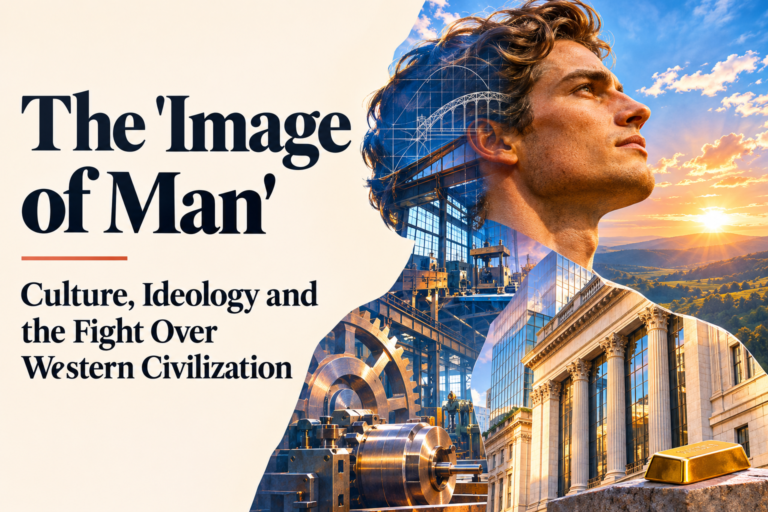
For Susan Kokinda, the fight between the “American System” and the imperial order is ultimately about the “image of man”: whether people are creators or animals to be managed. She argues that ideologies from “wokeism” to political Islam are tools to weaken nations, and names Gramsci, Soros and Chatham House as part of the story. Here is her argument, and where the historical record differs.
In an interview with Michelle Makori of Miles Franklin Media on 31 October 2026, Kokinda, a co-founder of Promethean Action and coalition vice chair of the Michigan Republican Party, described the deepest layer of what she sees as a clash between two systems. This is the fifth and last article in our series on the interview.
Creators or animals?
“At the most fundamental side is the question of the image of man,” Kokinda says. People who adhere to the imperial system, “when you scratch beneath the surface, they really think human beings are all just animals”, which, she argues, is where the idea that there are “too many people” comes from. Her answer is that humans solve problems: there are 8 billion people today, against a few million 10,000 years ago, because people “discovered new ways of exerting greater dominion over nature by using our God-given creative reason.”
She links this to Western civilization and to the monotheistic religions, which hold that “man is in the image of a creator”, and cites Secretary of State Marco Rubio’s speech on the Pnyx in Athens on 7 October 2026, in which he said “there is a rational order to the cosmos, governed by certain fundamental laws.” The empire, by contrast, believes “might makes right”: “whoever has the most money, the most power gets to impose their will.”
The two views lead to two economics, she argues. If people are creators, the aim is to expand production so that everyone prospers. If they are not, the aim is to loot. She accuses the IMF and the World Bank of keeping developing countries backward by controlling their currencies and commodity prices and imposing conditions on loans: “They won’t let them have nuclear power.” (The World Bank did refuse to finance nuclear plants for decades, but lifted that ban in June 2025.) She welcomed Treasury Secretary Scott Bessent’s statement to the IMF in October, which called for dropping “inefficient and distortionary climate finance targets” and announced a US contribution to a World Bank fund for nuclear energy in developing countries.
Why break up cultures?
Asked why the “globalists” would want to weaken national cultures, Kokinda returns to the same point. People “nurtured with a sense of the power of your mind, the beauty of your culture, the depth and the strength of your history” will not accept policies that throw them “on the scrap heap.” Empires, she says, “cannot rule in societies where people have that kind of identity.” That, in her view, is why resistance to globalization has been strongest in the United States, a country of people “who push the frontiers, who build, who create.”
Gramsci and the “culture first” strategy
Kokinda points to Antonio Gramsci, the Italian communist leader jailed by Mussolini’s regime from 1926 until shortly before his death in 1937. In his prison notebooks, Gramsci asked why the workers’ revolution in Russia had not spread to the West, and concluded that the ruling order in Western societies rested on consent shaped by culture, what he called “hegemony”, so that changing a society meant winning its culture first. Kokinda argues that this strategy has been applied throughout the post-war period, attacking “the Judeo-Christian fabric of America” and leaving people “floating around needing something to cling to,” from “wokeism” to “transgenderism.”
One detail needs correcting: Kokinda says Gramsci’s work got out of prison “thanks to the British.” His notebooks were smuggled out by his sister-in-law, Tatiana Schucht, and his main outside support came from Piero Sraffa, an Italian economist then at Cambridge University, who paid for his books and passed on messages. The British state played no part, and the notebooks were published in Italy after the war.
Her most interesting point may be about young people drawn to socialism. Their grandparents, she says, may have lost their jobs to NAFTA, their parents their homes in 2008 while the big banks were bailed out, and they themselves their first businesses in COVID. Telling them “how bad socialism is” doesn’t work, she argues; the answer is to show them “industrial capitalism as opposed to finance capitalism”, which “every time we’ve used it, it’s worked.”
Political Islam, Qatar and immigration
Makori asked whether Qatari money, rather than Britain, is the real foreign influence on American universities and media. Kokinda answered that Qatar has a lot of money, but that anyone who thinks Qatar is “the head of the octopus is really not a very good investigator.” She argues that political Islam, as distinct from the faith of millions of Muslims, has been a tool of British imperial policy, and that the Muslim Brotherhood “was created by the British.” Combined with “unfettered immigration,” she says, it is being used to break up national cultures in Britain, France and beyond. Immigrants are fine, in her view, but “they should assimilate.”
The record is more limited than her claim. The Muslim Brotherhood was founded in 1928 in Ismailia, Egypt, by Hassan al-Banna, as a religious and social revival movement opposed to British rule. Al-Banna recorded an early donation from the British- and French-run Suez Canal Company towards its first mosque, but historians do not regard that as British creation. Historians have documented British dealings with it and with other Islamist groups: the book Kokinda has in mind, Mark Curtis’s Secret Affairs: Britain’s Collusion with Radical Islam (2010), describes a British embassy arrangement to subsidize the Brotherhood in 1942 and later plots against Egypt’s Nasser. Curtis argues that Britain used such groups for its own ends; he does not argue that Britain created the Brotherhood.
Soros, Popper and Chatham House
On George Soros, whose foundations and political committees fund progressive causes, including campaigns for local prosecutors, Kokinda says she doesn’t know why he does what he does, but points to “who trained him in London”: the philosopher Karl Popper, under whom Soros studied at the London School of Economics after the war. She reads Popper as teaching that “there are no universal principles”, which she calls the core precept of imperialism. Popper’s own argument in The Open Society and Its Enemies was different: that because no one has a monopoly on truth, government must stay open to criticism and accountable, a case he made against both fascism and communism.
Kokinda also repeated the claim that Soros and his father “worked for the Nazis expropriating property” in Hungary. That claim is false. Soros was 14 in 1944 and living in hiding in Budapest under a false Christian identity his father obtained for him; he once accompanied the official sheltering him on an inventory of a Jewish family’s estate, and has said, “I had no role in taking away that property.” Fact-checkers including Snopes have found no evidence that he or his father worked for the Nazis.
Her view of Chatham House and the Council on Foreign Relations rests on a real piece of history. Both came out of a meeting of British and American delegates at the Hotel Majestic during the 1919 Paris peace conference, convened by Lionel Curtis of the Round Table movement, which planned a joint Anglo-American institute. Kokinda sees this as a British plan to bring the United States back into the imperial fold “not militarily but by co-opting them in terms of their institutions.” Historians generally describe the founders’ aim as closer Anglo-American cooperation after the First World War.
What critics say
- Cultural change has many causes. Most historians and sociologists see changes in religion, family life and identity as the product of economics, technology and generational change, not of a strategy steered from London or traced back to Gramsci.
- A single hidden hand explains too much. Linking Gramsci, Soros, political Islam, immigration and climate policy to one imperial system makes the theory hard to test, and several of the specific claims behind it do not hold up.
- The “image of man” debate is real. Whether human ingenuity can outrun population and resource limits is a long-running argument among economists, ecologists and philosophers, one in which Kokinda’s optimism has serious company.
Kokinda closes on a hopeful note. A midterm defeat, she says, would not be the end: “if you fight the right way, if you fight for principle,” even a loss “can put you in a better situation to win the ultimate fight.” That fight, she says, is “the destruction of this British imperial system in its modern-day manifestation so that the sovereign nations of the world have the opportunity to actually develop,” so that people in Africa, Asia and South America can have a decent standard of living.
The series: 1. The great systemic clash · 2. Triffin, debt and gold: is a “Bretton Woods 2.0” on Trump’s table? · 3. Tariffs, tax breaks and credit: is America’s factory revival real? · 4. Sovereignty versus empire: Iran, Ukraine and a Trump–Putin–Xi summit · 5. The “image of man”: culture, ideology and the fight over Western civilization.