Susan Kokinda sees Trump’s foreign policy as a break with the “rules-based international order”: deals between sovereign nations instead of rules set by Western institutions, sanctions instead of war where possible, and perhaps a three-way summit with Vladimir Putin and Xi Jinping in Shenzhen this month. Ukraine fears a new Yalta. Here is her view of Iran, Russia, China and the summits, alongside what has actually happened.
In an interview with Michelle Makori of Miles Franklin Media on 31 October 2026, Kokinda, a co-founder of Promethean Action and coalition vice chair of the Michigan Republican Party, applied her framework of two opposing systems, a sovereign American System and a British-centred imperial order, to world affairs. This is the fourth article in our series on the interview.
The end of the “rules-based order”?
Kokinda cites a seminar at Chatham House, the London foreign-policy institute, where a senior British figure said, as she recalls it: “The rules-based international order only works if it’s enforced, and the only country that can enforce it is the United States.” Once Trump decided “to not play ball”, she says, the old order had a problem. In its place, she argues, Trump has built bilateral relationships with Russia, China, India and Japan, countries “you could begin to bring together to talk about a new international financial system, exiting from this globalist system.” Russia would like that, she says, as would “a lot of the new governments in South America”; she would not guess about China, India or Japan.
A Trump–Putin–Xi summit
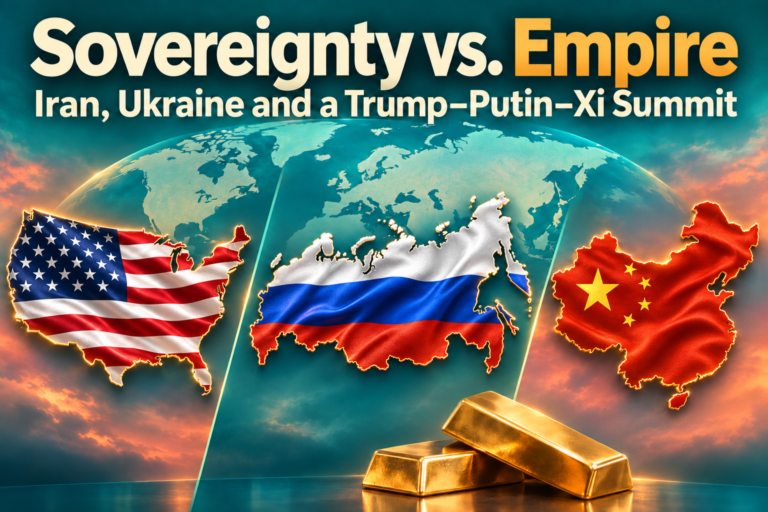
Kokinda expects a three-way meeting at the APEC leaders’ summit in Shenzhen on 18–19 November, where she believes Trump’s priority will be nuclear disarmament. The record so far:
- 1 September: Kremlin aide Yuri Ushakov said a three-way meeting had been discussed.
- 19 October: Trump said: “If President Xi wants to have it, I’d have it… to talk about nuclear weapons and denuclearization”, adding it would be “not so much for Ukraine.”
- Late October: the Kremlin said the meeting was “being prepared”, while China’s foreign ministry has called three-way nuclear talks “unrealistic” for now. No trilateral meeting has been confirmed.
Ukraine’s President Volodymyr Zelensky is wary. “We really don’t want this to turn into ‘Yalta 2, 3, 4’, with a redistribution of influence,” he said on 28 October, referring to the 1945 conference at which Roosevelt, Churchill and Stalin shaped post-war Europe. Kokinda turns the fear around: the people who dislike the idea of the United States, Russia and China talking, she says, are “the old imperial system who think they have the right to decide how to run the world.”
She traces that to British geopolitics, and in particular Halford Mackinder, whose “Heartland” theory (first set out in 1904 and summed up in 1919 as “Who rules the Heartland commands the World-Island; who rules the World-Island commands the World”) made control of Eurasia, and therefore Russia, the key to world power. Keeping the great powers, now the US, Russia, China and India, in “a perpetual kind of conflict”, she argues, has been “one of the central tenets of this globalist system.”
China: “more complicated”
China’s entry into the World Trade Organization in 2001 helped its rise, and Kokinda calls China “much more complicated” than Russia: “there’s certainly forces hostile to the United States in China,” she says. But she quotes Trump’s view that China simply “took advantage of what idiots in the United States and Europe did.” Her argument is that nations behave differently when they no longer believe the globalists have “ultimate complete control”: with a US president “standing for the principle of sovereignty, not just for his own country but for the world,” she says, governments feel “emboldened that they don’t have to bow down to this imperial system.”
Iran: sanctions first
The war with Iran is the backdrop to the midterms. US and Israeli strikes on 28 February killed Supreme Leader Ali Khamenei; Iran closed the Strait of Hormuz; ceasefires in April and June broke down in July. In late September only about 31 ships a day were crossing the strait, against 138 before the war, and Iran says it stays closed until its conditions are met. On 24 August, Treasury Secretary Scott Bessent launched Operation Economic Outcast to cut the Revolutionary Guards’ networks off from the financial system.
Kokinda believes the economic squeeze is working and that Trump “does not want to turn this country into a parking lot.” She sees the Revolutionary Guards as “almost like an occupying force” and expects perhaps “some limited surgical stuff immediately after the midterms,” with a settlement soon after, though if Trump “has no choice,” she says, “he will move back toward the kinetic.” She accuses Iran of stalling in the hope that a Democratic Congress would restrain Trump.
She also uses the Hormuz crisis as evidence of the City of London’s power, saying Lloyd’s of London was “pulling the plug” on the Strait of Hormuz. That is partly right: in early March, the main protection-and-indemnity insurers cancelled their war-risk cover for the Gulf after their reinsurers withdrew. But the Lloyd’s market itself kept writing cover at a price (2% to 6% of a ship’s value per transit by July), and a Lloyd’s consortium added $1 billion of Hormuz war cover in April. Traffic collapsed because of the attacks themselves.
Ukraine, Congress and the midterms
Kokinda expects Trump to face more resistance on Ukraine than on Iran, because most of the Republican Party still backs Kyiv. But she argues that even a Democratic Congress after the 3 November midterms could do little to stop his foreign policy: an impeachment would need two-thirds of the Senate to convict, and overriding a veto needs two-thirds of both houses. She did not predict the result, beyond suspecting the Republicans would hold the Senate.
Makori cited a Chatham House warning that Trump could emerge from the midterms “unshackled from electoral constraints”, and Kokinda agreed he “could be unshackled.” We could not find that phrase on Chatham House’s website; the closest published piece, from 9 September, says the Republican trifecta “removed constraints on his authority” and that a Democratic win would not automatically restrain him.
Asked about critics who call Trump a “buffoon”, Kokinda said people should look at what the administration does rather than at headlines. Her example is Greenland: after tariff threats against European allies in January, Trump announced a “framework” at Davos and dropped the tariffs, and on 22 September the US, Denmark and Greenland signed an Arctic security agreement that expands US bases and access while sovereignty stays with Denmark and Greenland.
What critics say
- Great-power deals leave smaller countries out. That is Ukraine’s fear about Shenzhen, and that of the Baltic states, Taiwan and others whose security depends on rules rather than on the goodwill of larger neighbours.
- The “rules-based order” is also American. The United States wrote much of it and has benefited from it, including the dollar’s central role in trade and finance.
- Sanctions push countries to build alternatives. Secondary sanctions such as Operation Economic Outcast give targets and their trading partners a reason to settle trade outside the dollar, one reason central banks have been buying gold.
- The war has a cost at home. The Hormuz closure has kept crude oil around or above $100 a barrel and helped push US inflation to 3.7%.
Why it matters for markets
Three things to watch in November: the midterms on the 3rd, whatever happens with Iran after them, and whether Trump, Putin and Xi meet in Shenzhen on the 18th and 19th. Any reopening of Hormuz would lower oil prices and inflation expectations; a lasting split between the dollar system and sanctioned economies would support central-bank demand for gold. US oil stocks and prices are on the crude oil inventories page, and gold’s reaction to past midterms on gold after US midterm elections.
The series: 1. The great systemic clash · 2. Triffin, debt and gold: is a “Bretton Woods 2.0” on Trump’s table? · 3. Tariffs, tax breaks and credit: is America’s factory revival real? · 4. Sovereignty versus empire: Iran, Ukraine and a Trump–Putin–Xi summit · 5. The “image of man”: culture, ideology and the fight over Western civilization.
This article summarizes the views Susan Kokinda expressed in an interview with Miles Franklin Media (31 October 2026), with events checked against news reports and context added by Corgano. Her views are her own. This article is commentary; it is not investment, tax or financial advice.