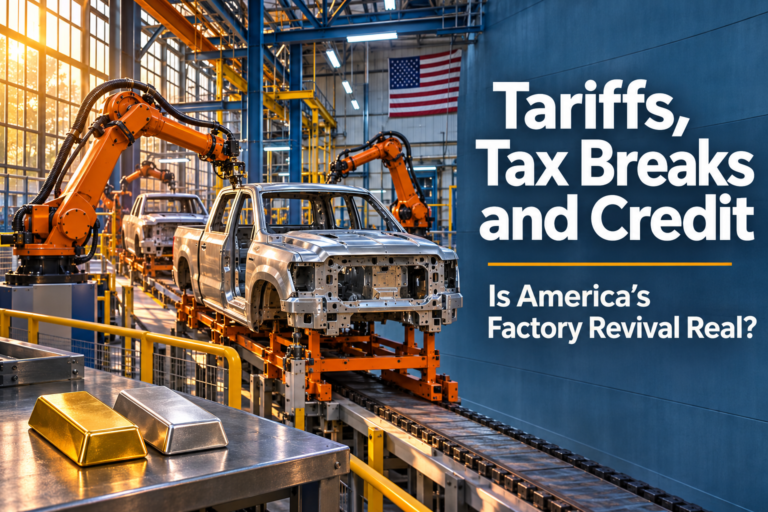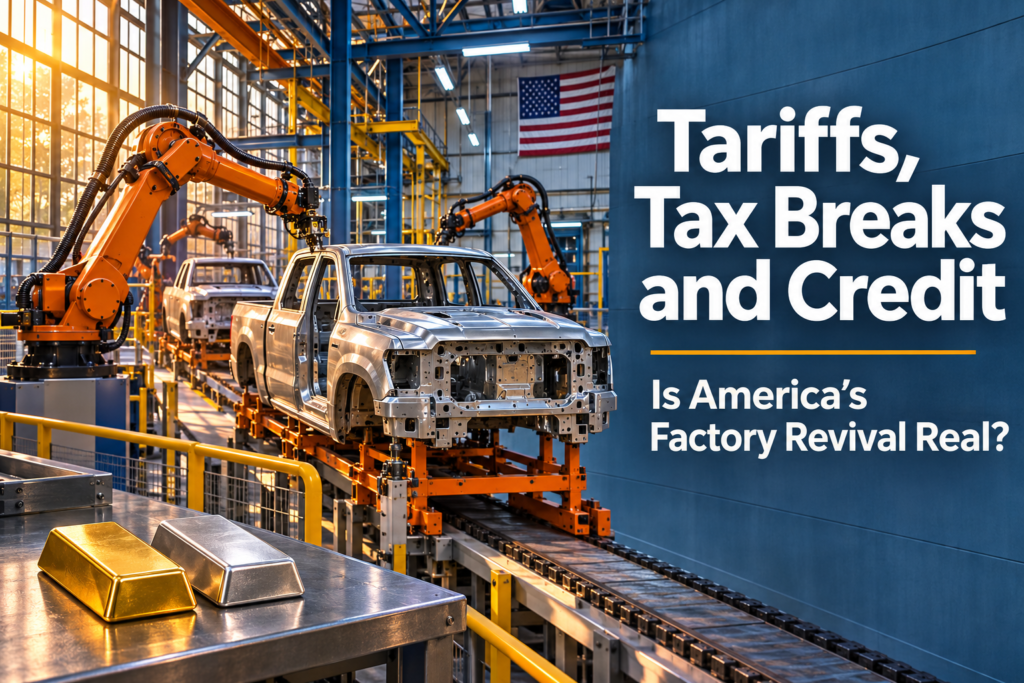
Susan Kokinda says America’s factory revival has already begun, driven by three tools: tariffs, a 100% write-off for new factories and government credit for strategic industries. The official data show manufacturing jobs have stopped falling, up 72,000 since December 2025, but the gains are still small, and the tariff toolkit was reshaped by a Supreme Court ruling in February. Here is her case, checked against the numbers.
In an interview with Michelle Makori of Miles Franklin Media on 31 October 2026, Kokinda, a co-founder of Promethean Action and coalition vice chair of the Michigan Republican Party, argued that the Trump administration is rebuilding what she calls the “American System”: an economy organized around producing things rather than consuming them on credit. This is the third article in our series on the interview.
Producers, not consumers
Kokinda, who lives on the outskirts of Detroit, starts from her own region. “In 1960, Detroit had the highest per capita standard of living in the country,” she says, built on blue-collar jobs where “one income could raise a family.” (The claim is widely repeated, but we could not find census data ranking Detroit first; it was certainly among the most prosperous US cities.) Henry Ford, she points out, became very rich, but by producing cars and raising his workers’ pay with the $5 day he announced in January 1914. Being rich does not make someone an oligarch, she argues; an oligarchy is a system that keeps the rest of the population backward so it can be looted.
Free trade, in her account, was sold to Americans as consumers (“you can buy stuff cheaper”) and cost them as producers. She blames NAFTA, free trade and green policies, backed by Democrats and by what she calls “the old Bush Republicans” over the past 30 years, for hollowing out the working and middle class. She quotes Treasury Secretary Scott Bessent, who has said the Democrats’ approach was to “compensate the loser”: take away a good job and pay benefits instead.
What the data show
Kokinda says it took about a year to reverse the decline in manufacturing, because companies had to be convinced that the tariff and tax policies were permanent before they would build plants. The Bureau of Labor Statistics data broadly support her timing:
- Factory employment fell for 13 straight months through December 2025, its low point.
- January 2026 brought the first monthly gain, though employment was still about 82,000 below a year earlier.
- By September 2026 it was up 72,000 from the December low, according to the BLS (Kokinda said 78,000). The latest months were +20,000 in July, +15,000 in August and +9,000 in September.
She admits that is “not a lot in terms of the population”, but calls it “a dramatic change in the trajectory.” She says she has counted 55 new factories or expansions announced since the Republicans’ midterm convention in Dallas, most not yet reflected in the jobs figures. Several of the projects she mentions check out:
- General Motors said in June 2025 it would invest $4 billion to move production of the Chevrolet Equinox and Blazer from Mexico to Kansas and Tennessee from 2027. Kokinda credits the 100% write-off below, though GM’s announcement came a few weeks before the law was signed.
- Ford added a third crew of 1,200 workers at its Dearborn Truck plant in Michigan from early 2026 to build more F-150 pickups.
- Shipyards: Davie Defense began a $1 billion modernization of a Galveston, Texas, yard in June 2026 to build Coast Guard icebreakers, projecting about 2,400 direct jobs. The second very large yard is in Baltimore rather than Boston: in October, Anduril announced a $3.7 billion shipyard at Sparrows Point, expecting about 3,100 direct jobs.
- Iron ore: the Export-Import Bank approved a $770 million loan in September 2026 for Mesabi Metallics in Nashwauk, Minnesota, a stalled mine project it describes as the first new US iron ore mine in 50 years.
The toolkit: tariffs, taxes and credit
Kokinda describes the policy as “a carrot and a stick”: tariffs to make importing more expensive, tax breaks to make building at home cheaper, and credit for producers that private banks will not finance.
Tariffs. She concedes the Supreme Court “slowed things down.” On 20 February 2026, in Learning Resources v. Trump, the Court ruled 6–3 that the International Emergency Economic Powers Act does not authorize tariffs, striking down the “reciprocal” tariffs. Importers are being refunded: about $122 billion, including interest, had been certified for repayment by mid-September. The administration recalibrated with other laws: a temporary 10% global tariff under Section 122 from February to July, then “forced-labor” tariffs of 10% to 12.5% on 60 economies under Section 301, while the sector tariffs on steel, aluminium, cars and other goods under Section 232 stayed in place.
100% expensing. Kokinda calls this “one of the most important elements” of the One Big Beautiful Bill Act, signed in July 2025, and says that as far as she knows nobody has done it before. The law made 100% bonus depreciation permanent for equipment, and created something new: companies can deduct the full cost of a new factory building in the first year instead of over 39 years. The detail matters, though:
- It applies to buildings used to manufacture, produce or refine tangible goods, including agricultural and chemical production. Offices, administrative space and leased-out buildings don’t qualify.
- It is temporary: construction must start before 1 January 2029 and the building must be in service before 2031.
- The deduction is clawed back if production stops within ten years.
Strategic credit. Big banks, she argues, chase “fast hot profits” in derivatives and currency trading, and will not lend to a manufacturer whose modernization won’t pay off for two years. So the administration is lending through the government’s own agencies:
- The Export-Import Bank, founded in 1934.
- The Energy Department’s lending office, now renamed the Office of Energy Dominance Financing. Its 2026 deals include a $17.5 billion conditional guarantee for new nuclear reactors.
- The Pentagon’s Office of Strategic Capital. It was actually created under the Biden administration in December 2022. The 2025 budget law then gave it enough credit subsidy to back up to $100 billion of loans for critical minerals. Its loans include $620 million to Vulcan Elements and $80 million to ReElement for rare-earth magnets.
“Tariffs, taxes, and credit,” as Kokinda sums it up: channels for anyone who wants to produce, instead of “roadblocks” for the past 30 or 40 years.
What critics say
- The gains are small so far. 72,000 jobs in nine months is a turnaround from decline, not yet a boom. New plants are also heavily automated, so investment does not translate into jobs one for one.
- Tariffs are paid at home. Importers and consumers pay them, along with manufacturers that rely on imported parts and metals. US consumer prices rose 3.7% in the year to September, and the AAA national average for gasoline was about $4.17 a gallon on 1 November, down from a 2026 high of $4.41 on 1 October. Kokinda acknowledges the frustration: she pictures a voter who just “paid $4.50 at the gas pump.”
- Policy has been unstable. The Supreme Court ruling, the refunds and the switch between legal authorities are exactly the uncertainty that, by Kokinda’s own account, makes companies hesitate before building.
- Several of the incentives are temporary. The factory write-off ends for construction started after 2028, and the Pentagon’s new loan authority runs out in October 2028.
Kokinda’s answer is that voters should judge as producers, not consumers: “If people cast their ballots simply as a consumer and what they’re paying at the pump,” she says, they will probably not vote Republican; if they think about where the country is going, they will want the policies “in the pipeline” to continue.
Why it matters for markets
Reshoring is metal-intensive: factories, shipyards, power plants and magnets need steel, copper, silver and rare earths, and the administration is financing new mines to supply them. At the same time, tariffs and energy prices keep inflation high, and the Federal Reserve has started raising rates again, which weighs on gold and silver. The fed funds rate and economic calendar pages track the next decisions and data releases; gold after US midterm elections shows how the metal has moved after past midterms.
The series: 1. The great systemic clash · 2. Triffin, debt and gold: is a “Bretton Woods 2.0” on Trump’s table? · 3. Tariffs, tax breaks and credit: is America’s factory revival real? · 4. Sovereignty versus empire: Iran, Ukraine and a Trump–Putin–Xi summit · 5. The “image of man”: culture, ideology and the fight over Western civilization.
This article summarizes the views Susan Kokinda expressed in an interview with Miles Franklin Media (31 October 2026), with figures checked against official data and context added by Corgano. Her views are her own. This article is commentary; it is not investment, tax or financial advice.